


A foreign transaction fee is applied in the following situations:
Suggested Read: Best Credit Cards for International Travel
 Win Assured Cashback

Compare India’s best credit cards
See cards from top Banks & issuers

Choose card matching your lifestyle
Wide choice of 100+ credit cards

Pre-qualified offers, zero docs
Offers ranked according to eligibility


15.7L Reviews
 Airport Lounge Access

 with Every Card
Choose a Card Matching
Your Lifestyle

Filters


Max. 3 selections allowed

Compare

Travel

Lounge Access
 Unlimited domestic airport lounge access
 Up to 20% Scapia coins on card spends
No forex mark-up on international spends
 Joining Fee: ₹0+ Taxes

 Annual/Renewal Fee: ₹0+ Taxes
Compare
*Terms & Conditions

Compare
Travel
Zero forex mark-up charges
Up to 10% off on travel via Ixigo
Upto 5% rewards on spends
Joining Fee: ₹0+ Taxes
Annual/Renewal Fee: ₹0+ Taxes
Compare
*Terms & Conditions

Compare
Travel

Rewards
Zero foreign currency markup fee
8 domestic lounge visits per year
2.5X reward points on travel spends
Joining Fee: ₹3,000+ Taxes
Annual/Renewal Fee: ₹3,000+ Taxes
Compare
*Terms & Conditions

Compare
Travel
Lounge Access
Rewards
Zero forex markup on international spends
Up to 16 international lounge visits per year
Up to 10X rewards on every spend
Joining Fee: ₹5,999+ Taxes
Annual/Renewal Fee: ₹5,999+ Taxes
Compare
*Terms & Conditions

Compare
Travel

Premium
Rewards
Accor Plus, Club Marriott & Taj Hotel Membership
Unlimited access in India and abroad
15 EDGE rewards for every Rs. 200 spent
Joining Fee: ₹50,000+ Taxes
Annual/Renewal Fee: ₹50,000+ Taxes
Compare
*Terms & Conditions

Compare
Travel

Movies
Rewards
Up to 32 free airport lounge visits per year
Low forex mark-up fee of just 0.99%
Up to 16 free movie tickets in a year
Joining Fee: ₹4,999+ Taxes
Annual/Renewal Fee: ₹4,999+ Taxes
Compare
*Terms & Conditions

Compare
Travel
Premium
Rewards
Unlimited access for primary & add-on user
Up to 4.5% back as reward points
Save up to Rs. 2,400 per month on BookMyShow
Joining Fee: ₹9,999+ Taxes
Annual/Renewal Fee: ₹4,999+ Taxes
Compare
*Terms & Conditions

Compare
Travel
Rewards
Zero forex mark-up fee on international spends
Up to 4 domestic lounge visits per year
Buy 1, Get 1 movie ticket, twice a month
Joining Fee: ₹0+ Taxes
Annual/Renewal Fee: ₹0+ Taxes
Compare
*Terms & Conditions

Compare
Lounge Access
Movies
Rewards
Movie tickets worth Rs. 6,000 every year
Up to 50,000 bonus reward points annually
Vouchers worth Rs. 5,000 on card activation
Joining Fee: ₹4,999+ Taxes
Annual/Renewal Fee: ₹4,999+ Taxes
Compare
*Terms & Conditions

Compare
Travel
Premium

Invite Only
3.33% value-back across all categories
Unlimited access in India and abroad
Save on your stay at ITC and Marriott Hotels
Joining Fee: ₹12,500+ Taxes
Annual/Renewal Fee: ₹12,500+ Taxes
Compare
*Terms & Conditions


Compare India’s best credit cards
See cards from top Banks & issuers
Choose card matching your lifestyle
Wide choice of 100+ credit cards
Pre-qualified offers, zero docs
Offers ranked according to eligibility
15.7L Reviews
A foreign transaction fee is applied in the following situations:
Suggested Read: Best Credit Cards for International Travel
From a bank’s perspective, you can conduct only two types of foreign transactions namely:
When you conduct a transaction in USD, your Indian credit card first converts the amount into Indian Rupee. They then apply the foreign transaction mark-up fee on the amount. You will have to pay this amount as the Forex Mark-up Fee.
Foreign Transaction Fee Calculation
For example, if you purchased an item worth 100 USD and the exchange rate is 1 USD = INR 70. In this case, the payable amount in INR will be Rs. 7,000. Now if the foreign exchange mark-up fee is 3.5%, it will be Rs. 245 (3.5% of 7,000). GST at 18% will also be applicable on the fee amount.
In some cases, when you conduct a foreign transaction in any currency other than US dollars then the amount is first converted into US dollars. Afterwards, the usual process takes place and the amount is converted into Indian Rupees. The mark-up fee is applied at this juncture and the final amount shows up on the customer’s credit card statement .
You may incur the following credit card charges when conducting international transactions. Note that these charges are not necessarily applicable; they are subject to the situations as mentioned below.
Tax - Goods & Service Tax (GST) will be applicable on all the fees and charges that your international transactions incur. It is currently at 18%.
Cash Withdrawal Fee - Cash withdrawals done overseas like any domestic withdrawals will incur this fee. The minimum amount can range from Rs. 100 to Rs. 300 and maybe more.
Finance Charges - If you withdraw money or fail to clear your dues by the due date, then finance charges will be applied. The rate can be anywhere between 23% and 42%, may vary across card type and issuers.
Suggested Read: Forex Cards vs Credit Cards - Which is Better for International Travel?
Explore Our
Credit Card Partners
Step 1: Enter your mobile number
Step 2: Enter OTP to verify your mobile number
Step 3: Explore pre-qualified credit card offers from top issuers
Step 4: Select your preferred card and complete the digital application
No, cash transactions, traveller’s cheques, Forex cards and certain credit cards do not charge a mark-up fee.
Amongst the three, a credit card is the best monetary instrument for international travel. This is especially true if the card charges 0% currency conversion fee. They also keep your finances secure. Meaning you can cancel/dispute a transaction later on. This facility is not provided by the other two means. Also, cash & travellers’ cheque can be easily misplaced or stolen. Though, you get a small window of time to cancel travellers’ cheques. Travellers’ cheques also require that you pay a commission fee to get them and use them. They are also prepaid.
At the time of credit card application, you were handed a Most Important Terms & Conditions handbook. You can find the rate under Foreign Currency Transactions fee. You may also contact the credit card provider to know the foreign transaction fee.
If you fail to pay your whole bill regardless of its contents by the due date then finance charges will be applied.
Credit card providers don’t usually set a separate international spend limit. However, some banks allow users to set an international spend limit. You also have the option to activate or deactivate international spends.
A foreign transaction fee, also known as a forex markup fee, is charged by your bank or card issuer when you make a payment in a foreign currency or through an international merchant.
You can avoid foreign transaction fees by using credit card that offer zero forex markup or no foreign transaction charges. Always choose to pay in the local currency instead of INR to prevent extra costs due to dynamic currency conversion.
Paying in INR abroad usually does not help you avoid foreign transaction fees. In fact, merchants often apply dynamic currency conversion (DCC), which converts the amount to INR at a poor exchange rate and may include extra markups. Therefore, you may end up paying more even though the transaction is in INR.
Yes, foreign transaction fees can apply even to online purchases if the merchant is based overseas or charges in a foreign currency. Even if you are shopping from India, your bank may treat the payment as an international transaction and levy the applicable forex markup fee.
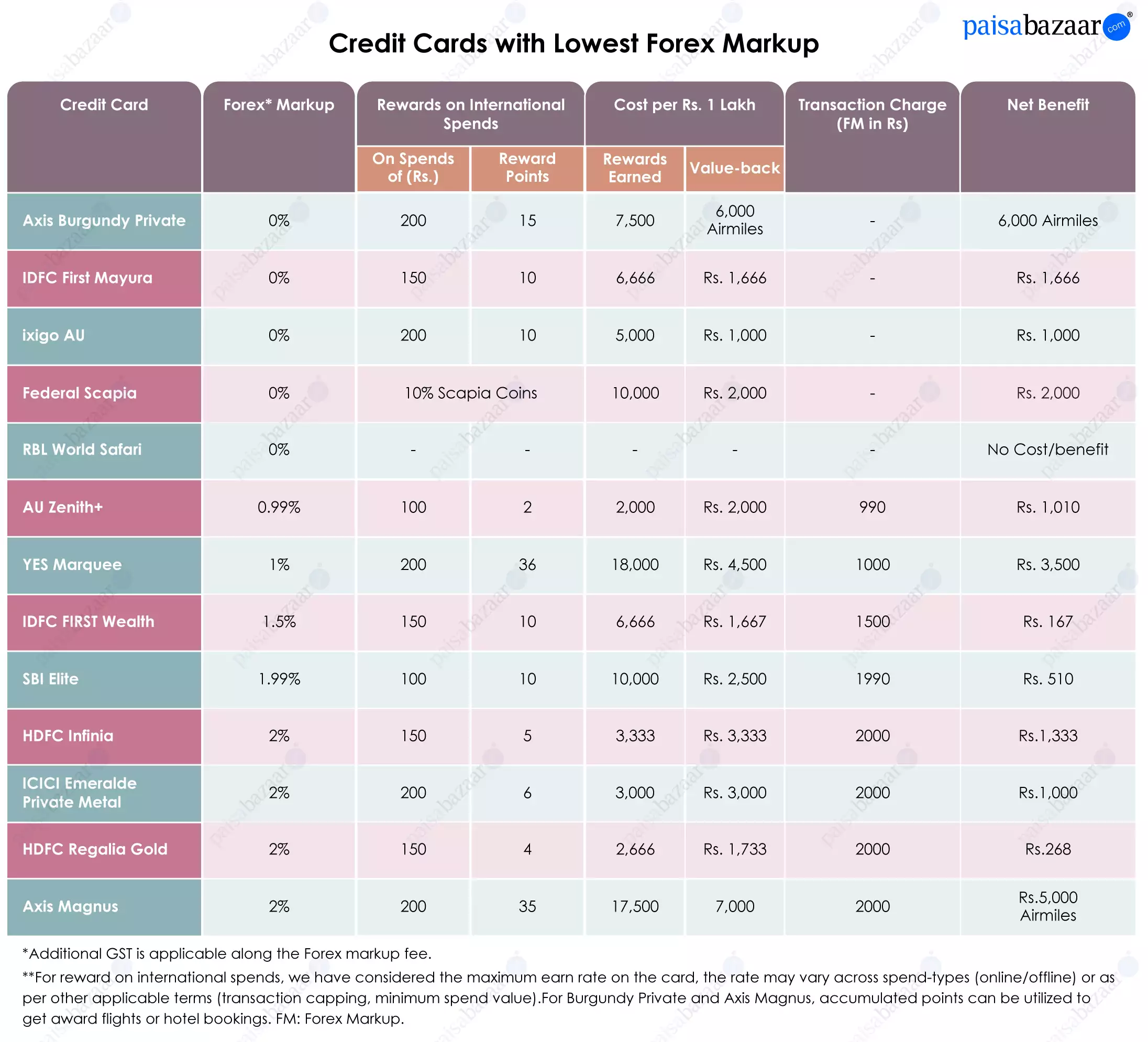
Some of the popular options include Federal Scapia, Ixigo AU, RBL Bank World Safari, and IDFC FIRST Mayura Credit Card. These cards are ideal for frequent travellers who wish to save on international spends.

IDFC FIRST Bank Introduces Zero Forex Mark-up Across Credit Cards


Latest Axis Bank Credit Card Updates 2026


What is a Supplementary Credit Card?
What is a Forex Markup Fee? Meaning and How to Avoid It


Benefits of a Secured Credit Card: A Smart Way to Build Credit History

Cooling-Off Period After Credit Card Rejection: How Long Should You Wait?

Credit Card Spending & Income Tax Scrutiny Limit 2026

Does an FD-backed Credit Card Help Housewives Build Credit in India?
How to Close an FD Credit Card

How to Check Airport Lounge Access on Credit Card


Great Lounge Access Benefit

Excellent Experience with PB Pass
Very helpful throughout the entire card process
Satisfied with Paisa Bazaar credit card application process
Multiple Cards to Compare, Smooth Experience
Got Cashback
User Friendly and Fast
Best for Card Comparison
Reward Calculator
Pre-Approved Card


Paisabazaar is a loan aggregator and is authorized to provide services on behalf of its partners
*Applicable for selected customers


