Download the
Paisabazaar app Today!
Paisabazaar app Today!
Get instant access to loans, credit cards, and financial tools — all in one place

Win Assured Cashback

Our Advisors are available 7 days a week, 9:30 am - 6:30 pm to assist you with the best offers or help resolve any queries.


Get instant access to loans, credit cards, and financial tools — all in one place

Scan to download on



 Personal Loan
 Business Loan
 Home Loan
 Other Loans


Our Advisors are available 7 days a week, 9:30 am - 6:30 pm to assist you with the best offers or help resolve any queries.

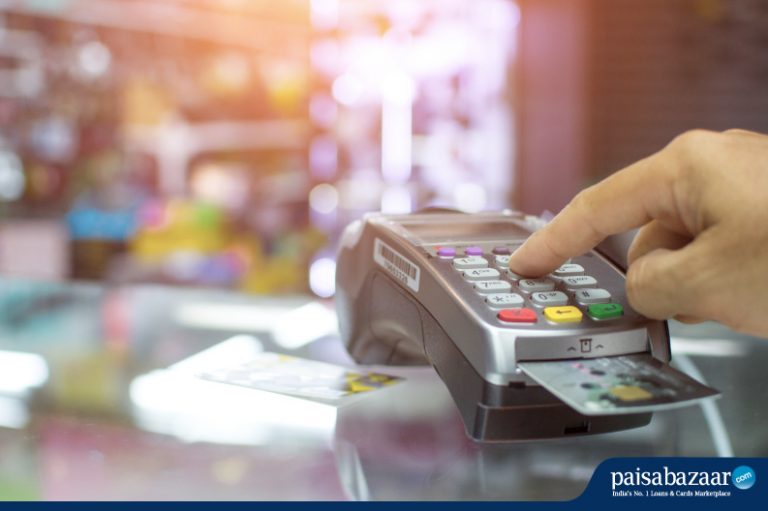
When you use your credit card for shopping at a store, you just have to swipe the card and the transaction is complete within seconds. But have you ever wondered what goes on behind the scenes for processing this transaction? Swiping the credit card in a Point of Sale (POS) machine is only the first step; it is followed by a rather complex procedure that involves multiple parties. First, let us talk about the participants of a credit card transaction.
Following parties are involved in processing the entire transaction when you use your credit card or debit card at a merchant terminal or at an online payment gateway.
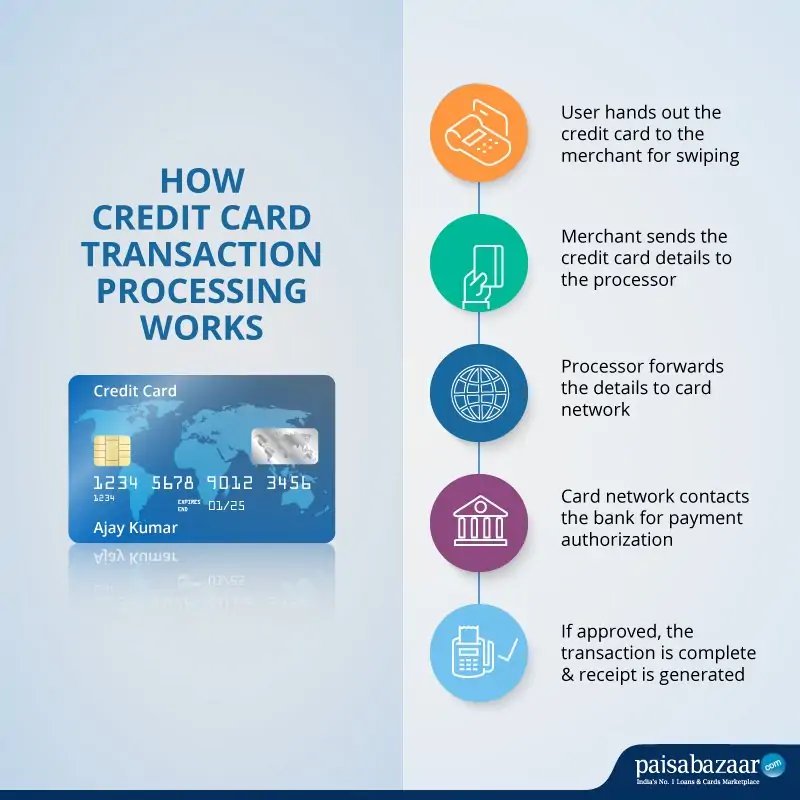
The payment process begins with the cardholder either by swiping/dipping the card in the Point of Sale (POS) terminal or by entering the payment information in a payment gateway. The merchant then accepts this information in one of the two ways- card present (at a store using POS) or card not present (through an online payment gateway).
Next, the credit card processor collects this payment information and routes it to the next stages for authentication. Card processor acts as a communication link between the different parties involved in the transaction. From here, the information goes to the card network.
The card network is responsible for securely passing on the payment request to the issuing bank. The bank then validates the card details with the related account to find out if there’s enough balance or credit limit. The approval or rejection of the transaction is also up to the issuing bank. It sends the appropriate response through the same channel- card network and processor. After this, the message will be shown to the merchant as directed by the issuing bank. If approved, the transaction is complete. However, this does not mean the merchant has received the amount. An amount is deducted from the user’s account but the actual clearing happens after some time or maybe after a few days depending on the card network. Visa and MasterCard have a comparatively faster clearing mechanism than Discover and American Express.
There may be several reasons why your payment is declined. In such cases, the POS machine would show the error code which will help the merchant determine the reason of rejection. In case the machine does not show any code, you would have to call the customer care of your bank to find out why your payment was declined.
Some common reasons for payment decline include-
Also Read: Unauthorized Transactions on Credit Card: What Should You Do?
Sometimes, you may have faced a situation wherein the merchant does not want to take a credit card for payment. This is because merchants are required to pay an interchange fee for accepting credit card payments. Some other charges may also be involved. Let us discuss these costs in some detail-
Suggested Read: Best Co-branded Credit Cards in India
Out of the total processing fee, interchange fee usually accounts for 3-5% and markup fee accounts for 25-30%. Assessment fee, if applicable, can make up to 75% of the card processing cost to the merchant. In addition to this, customers have the right to dispute payment in case of fraudulent transactions or other such circumstances. When such complaint is received by the issuing bank, they charge a penalty from the merchant for the same. And, if found guilty of such fraud, merchants have to pay the amount to the bank.

 Limited Time Offer


 with Every Card
Choose a Card Matching Your Lifestyle
Please enter a valid full name
 +91
+91
The entered number doesn't seem to be correct
