Download the
Paisabazaar app Today!
Paisabazaar app Today!
Get instant access to loans, credit cards, and financial tools — all in one place

Win Assured Cashback

Our Advisors are available 7 days a week, 9:30 am - 6:30 pm to assist you with the best offers or help resolve any queries.

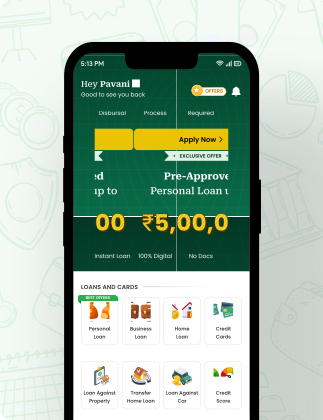
Get instant access to loans, credit cards, and financial tools — all in one place

Scan to download on


 Personal Loan
 Business Loan
 Home Loan
 Other Loans


Our Advisors are available 7 days a week, 9:30 am - 6:30 pm to assist you with the best offers or help resolve any queries.


Here’s a list of charges:
| Description | Charges |
| Joining fee for FD of ₹2000 (Minimum FD Amount: ₹2000) |
₹500 + 18% GST |
| Joining Fee for FD of ₹5000 | ₹250 + 18% GST |
| Joining Fee for FD more than ₹5000 | NIL |
| Annual Fee/Renewal Fee | ₹0* |
*With effect from 20th November 2023
Goods and Services Tax (GST) is applicable on all fees, interest and other charges and is subject to change as and when notified by the Government of India.
| Description | Charges | |
| Cash Advance Fees | 2.5% of amount withdrawal subject to ₹250 minimum | |
| Late Payment Charges | Outstanding Amount Due | Charge |
| Up to ₹100 | Nil | |
| Between ₹100 to ₹1,000 | ₹250 | |
| Between ₹1,000 and ₹10,000 | ₹500 | |
| More than ₹10,000 | ₹750 | |
| Over Limit Charges | NA | |
| Card Replacement Cost | ₹100+Taxes | |
| Foreign Currency Transaction Charge | 3.5% of the transaction amount | |
| Fuel Surcharge | Up to 2% of transaction amount | |
| Interest Free Period (Grace Period) | From 20 Days to Up to 50 Days | |
| Duplicate Statement (Beyond 3 Months) | ₹100 | |
| GST Applicable on Fees and Charges | 18% or as may be directed by Government | |
| Grace Period until Bill Payment | Payment Due Date + 3 Days | |
a. Interest will be charged if the Total Amount Due is not paid by the payment due date. Interest will be charged on the Total Amount Due and on all new transactions (from the transaction date) till such time as the previous outstanding amounts are paid in full.
Also, interest will be levied on all cash advances from the date of the transaction until the date of payment.
b. The rate of interest may be changed at the sole discretion of SBM Bank.
c. The following illustration will indicate the method of calculating interest charges: In the table given below, it has been assumed that the Total Amount Due of the previous month statement has been paid by the payment due date and there is no outstanding amount. The statement date is the 20th of every month. Given these assumptions, interest will be calculated as below:
| Transaction Description | Amount in INR |
| Purchase on 15th Jan 2020 | 5000 |
| Total Amount Due on Statement Dated 20th Jan 2020 | 5000 |
| Minimum Amount Due on Statement Dated 20th Jan 2020 | 250 |
| Payment Due Date 9th Feb 2020 | |
| Purchase on 12th Feb | 4000 |
| Payment Made on 15th Feb 2020 | 6000 |
| Interest Calculations @42.58% PA | |
| Interest on ₹5000 for 30 Days (15th Jan -15th Feb) | 147.92 |
| Interest on ₹3000 for 8 Days (12th – 20th Feb 2020) | 23.42 |
| Total Interest Charged | 171.34 |
GST will be applicable on interest charges.
Please remember that this facility of an interest-free period will not be available to you if you have not paid the previous month’s outstanding amount in entirety.
a. The grace period could range from 20 to 50
b. Illustrative Example for the calculation of grace period:
Thus, the grace period can vary depending upon the date of purchase. However, if the Total Amount Due is not paid by the payment due date, then there will be no interest free period. For cash advances, interest is charged from the date of the transaction until the date of payment.
| Description | Charges | ||
| Overdue Interest on Extended Credit | Interest on Cash Advances | ||
| Annual | Monthly | Annual | Monthly |
| 42.58% | 3.00% | 42.58% | 3.00% |
| Interest | Interest Free Period** | Upto 48 days 3.00% per month 42.58% per annum |
** Interest Free Period: Please remember that this facility of an interest-free period will not be available to you if you have not paid the previous month’s outstanding amount in entirety.
Late Payment charges will be levied in case a credit card account (statement outstanding balance) on customer remains “past due” for more than 3 days. The number of “days past due” and late payment charges will be computed from the payment due date. You are charged a Late Payment Fee if there has been no payment or a payment less than the Minimum Amount Due is received by the Payment Due Date +3 days. Late Payment Fee shall be charged on the outstanding amount.
Illustrative Example for Calculation of Late Payment Charges:
The following illustration will indicate the method of calculating interest charges: In the table given below, it has been assumed that the Total Amount Due of the previous month statement has been paid by the payment due date and there is no outstanding amount. The statement date is the 20th of every month. Given these assumptions, interest will be calculated as below:
| Transaction Description | Amount in INR |
| Purchase on 15th Jan 2020 | 5000 |
| Total Amount Due on Statement Dated 20th Jan 2020 | 5000 |
| Minimum Amount Due on Statement Dated 20th Jan 2020 | 250 |
| Payment Due Date 9th Feb 2020 | |
| Purchase on 12th Feb | 4000 |
| Payment Made on 15th Feb 2020 | 6000 |
| Interest Calculations @42.58% PA |
GST will be applicable on interest charges.
Payment of at least the Minimum Amount Due i.e., Rs. 100 in the above example, is required to be paid by the payment due date (9th Feb 2020), to ensure that no late payment charges are levied. If minimum amount due is not paid, late payment charges would be levied as per the below table:
| Outstanding Amount Due | Charge |
| Up to ₹100 | NIL |
| Between ₹100 to ₹1000 | ₹250 |
| Between ₹1000 and ₹10,000 | ₹500 |
| More than ₹10,000 | ₹750 |
Thus, in the above example, since the minimum amount due of ₹250 is not paid by the payment due date of 9th Feb 2020 and since Total Amount Due was ₹5000, late payment charges of ₹500 will be levied on 10th Feb 2020. This charge will also be applicable if you make a payment of less than the minimum amount due by the payment due date. GST will be applicable on late payment charges.
The credit limit on the Paisabazaar SBM-Step Up Credit Card shall be 90 percent of the fixed deposit amount. The said Credit Limit may be subject to change at the sole discretion of the Bank from time to time.
You shall be required to create the fixed deposit in the manner specified and upon execution of the relevant documents as specified by the Bank from time to time. The fixed deposit so created with the Bank shall be on auto renewal mode. By applying for the SBM-Step Up Credit Card and agreeing to the Terms contained herein, you hereby give your consent for the fixed deposit to be auto-renewed at the end of its tenure for a similar tenure as was booked at the start of the fixed deposit. In the event of closure of the SBM-Step Up Credit Card by you/Bank, the fixed deposit(s) linked to the SBM-Step Up Credit Card shall also be closed. Post the deduction of total outstanding, you get settlement of FD amount including interest earned for the tenure of closure to the source account number.
Available credit limit is calculated by deducting the utilized limit from the Total Credit Limit.
It is a part of credit limit which can be used for withdrawing cash from ATMs. The Credit Limit and Cash Withdrawal Limit are communicated at the time of delivery of the Card and are also indicated in the monthly statements.
All Card Member will be billed on a monthly basis for all charges incurred by the use of the Card and for all charges applicable to the Card account. In case the card was not used during the billing cycle, the billing statement will mention there were no spends in that month.
The billing statement will be dispatched on a monthly basis to you by e-mail. In case of any help needed, you may call Bank’s helpline number at 1800-103-3817 or write/visit Bank at: SBM Bank (India) Ltd. 101, Raheja Centre First Floor, Free Press Journal Marg, Nariman Point, Mumbai – 400021, Maharashtra
Without prejudice to the liability of the Card Member to immediately pay all charges incurred, the Card Member may exercise the option to pay only the Minimum Amount Due (MAD) indicated in the statement by the due date. The Minimum Amount Due shall be 5% of the outstanding amount. In case of any repayment through installments, the installment amount due during the statement period will be added to the Minimum Amount Due. If the total outstanding is more than the credit or cash limit, then the amount by which the credit or cash limit has been exceeded will also be included in the Minimum Amount Due. Minimum Amount Due shall also include unpaid Minimum Amount Due of the previous statements, if any. Interest will be charged if the Total Amount Due is not paid by the payment due date even if the Minimum Amount Due has been paid.
Payments towards the Card Account may be made in any of the following ways.
In the event the Card Member disagrees with the charges indicated in the statement, it should be communicated in writing to the correspondence address of SBM Bank within 60 (sixty) days of receipt of the statement, failing which it would be construed that all charges indicated in the statement are in order.
SBM Bank (India) Ltd. 101, Raheja Centre First Floor, Free Press Journal Marg, Nariman Point, Mumbai – 400021, Maharashtra, Tel No: +91 22 4302 8888
Card Issuer Contact Details : https://www.sbmbank.co.in/aboutus/contact-us.php
In case you need any help, you can:
If you are not satisfied with the response from regular channels, you can send an email to customercare@sbmbank.co.in or call bank’s toll free number 1800 1033 817.
The registered office of our bank is- SBM Bank India, 1st Floor, Raheja Centre, Registered Office :, Free Press Journal Marg, Nariman Point, Mumbai, Maharashtra 400021
In the event of a dispute, the Bank will make suitable amends to the reporting procedure before reporting the card holder as defaulter. However, it may also be noted that such disclosure/release of information would be contingent on time available to investigate and settle such disputes raised.
Beyond this level, you can reach out to the bank as per their escalation matrix.
https://www.sbmbank.co.in/aboutus/grievance-redressal-mechanism.php
If the issue remains unresolved beyond 30 days even after reaching out to the above channels, or if the response is unsatisfactory, you may write to the Banking Ombudsman for an independent review. Details of the Banking Ombudsman Scheme are available on the Reserve Bank of India (RBI) website at https://www.rbi.org.in/.