Download the
Paisabazaar app Today!
Paisabazaar app Today!
Get instant access to loans, credit cards, and financial tools — all in one place

Win Assured Cashback

Our Advisors are available 7 days a week, 9:30 am - 6:30 pm to assist you with the best offers or help resolve any queries.


Get instant access to loans, credit cards, and financial tools — all in one place

Scan to download on



 Personal Loan
 Business Loan
 Home Loan
 Other Loans


Our Advisors are available 7 days a week, 9:30 am - 6:30 pm to assist you with the best offers or help resolve any queries.
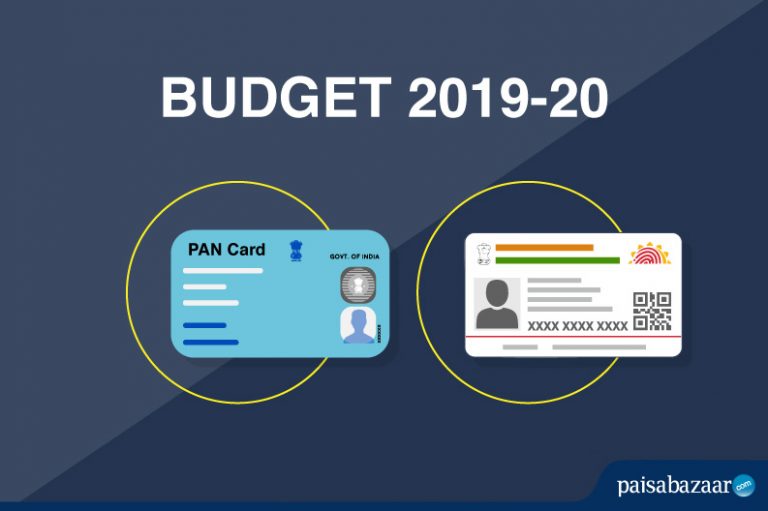
The Union Budget 2019-2020 presented by the Finance Minister had something for everyone, be it private sector employees, women, retailers and shopkeepers, farmers or entrepreneurs. The budget made way for several provisions that improve the ease of living for citizens. Many of those revolved around Aadhaar.
UIDAI, the Aadhaar issuing authority, has already generated more than 123 crore unique Aadhaar numbers till June 2019 with states like Punjab, Haryana, Telangana, Kerala, etc. registering more than 100% enrolment. Let us delve deep to find out what the budget had for Aadhaar and how the government is planning to make our life easier with the biometric identification document.
The Finance Minister, in her maiden budget speech, proposed that NRIs (Non Resident Indians) can now finally get Aadhaar card made as soon as they land in India. They will, however, have to furnish their passport mandatorily in such cases as the proof of identity and proof of address.
Earlier, an NRI could get enrolled for Aadhaar only after he had stayed in India for a period or periods amounting to 182 days or more in the past one year of applying for the Aadhaar card. However, with this announcement, NRIs will get the opportunity to get their Aadhaar made easily and without waiting for long.
Taxpayers can now furnish their Aadhaar card instead of PAN (Permanent Account Number) at the time of filing the Income Tax Returns. The finance minister has allowed assessees to quote their Aadhaar number instead of PAN if they do not have one. Aadhaar can now be quoted wherever mentioning PAN was necessary. This will add to the convenience of taxpayers who did not have PAN cards to file Income Tax Returns (ITR).
Taxpayers, who have filed Income Tax Returns using Aadhaar, will be allotted PAN on the basis of their Aadhaar. The IT Department will obtain the demographic details of the user from the UIDAI.
Taxpayers, who have already linked their Aadhaar with PAN cards, can use their Aadhaar number in place of PAN at the time of filing ITR for FY 2018-2019.
Ms. Sitharaman divulged that it will be mandatory for people to mention their Aadhaar or PAN at the time of making high value transactions. Earlier, it was mandatory to quote PAN at the time of making such transactions.
She also mentioned that the receiver of the PAN/Aadhaar from the applicant will have to authenticate it and shall check for its correctness. The government will amend the relevant penalty provisions to ensure the compliance of the updated provisions.
As per the present scenario, linking PAN card with Aadhaar is still mandatory. Those PAN cards that are not linked with Aadhaar card after 30th September 2019 will be liable to be deactivated. However, such people will still be able to file Income Tax Returns, but they will have to use their Aadhaar number instead. It is not sure, as of now, that what will happen to the past data of ITRs filed using the now inoperative PAN card.
As per Section 139AA of the Income Tax Act, 1961, it is mandatory to quote Aadhaar number (Enrolment ID if Aadhaar number has not been issued till now) at the time of filing ITR or applying for a PAN card. However, quoting Aadhaar and PAN was mandatory only for resident individuals. An NRI was not in the ambit of this rule as this section of the Income Tax Act did not apply to non-residents according to the Aadhaar Act, 2016.
However, with the government allowing NRIs to apply for Aadhaar card as soon as they return to India, it will be worth noticing what would happen to NRIs who do not link their PAN card with Aadhaar. As per experts, NRIs not having an Aadhaar card would still be allowed to file Income Tax Returns using their PAN only as mentioning Aadhaar number at the time of filing ITRs is not applicable for NRIs since July 2017.