Download the
Paisabazaar app Today!
Paisabazaar app Today!
Get instant access to loans, credit cards, and financial tools — all in one place

Win Assured Cashback

Our Advisors are available 7 days a week, 9:30 am - 6:30 pm to assist you with the best offers or help resolve any queries.


Get instant access to loans, credit cards, and financial tools — all in one place

Scan to download on



 Personal Loan
 Business Loan
 Home Loan
 Other Loans


Our Advisors are available 7 days a week, 9:30 am - 6:30 pm to assist you with the best offers or help resolve any queries.
600 or 750? What's your credit
score? Check for FREE.


Let’s Get Started
 +91
+91
The entered number doesn't seem to be correct
Online banking, also known as internet banking, is a banking method in which transactions are carried out over the internet. In the early 1980s, online banking began in New York, USA. Internet banking software can offer personal and corporate banking services with features such as account balances, statements, recent transactions and payments. Online banking used to be limited to exclusively online banks but it has become one of the most popular banking methods these days. Let us understand what is online banking in detail.
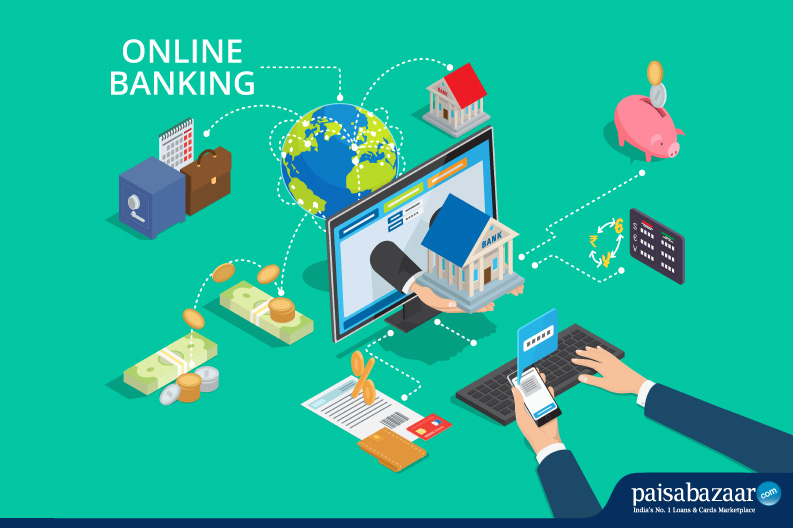
In order to access a financial institution’s online banking facility, a customer with internet access must register for the institution’s service and set up a password and other customer verification credentials. Financial institutions now routinely assign numbers of customers to access their online banking facility, whether or not customers have indicated their intentions.
Customer numbers are normally not identical to account numbers. A number of client accounts may be connected to one client’s customer number. Each financial institution can identify the types of financial transactions that can be transacted by online banking, but usually includes account balances, a list of recent transactions, online bill payments, investments and transfers of funds between a customer and another’s account.
The facility can also give the customer the opportunity to order a cheque book, statements and report loss of credit cards, stop paying on a cheque, change addresses and other routine actions instantly without visiting the bank.
| Online Banking | Mobile Banking |
| Financial transactions are conducted on the internet through the website of a bank. | Mobile banking refers to an internet based facility provided by banks that allows the customers to conduct bank transactions via mobile devices. |
| It is accessed through a browser via the computer or laptop. | It is accessed through an application on the mobile. |
| One can transfer money through NEFT, RTGS or IMPS. | One can transfer funds through NEFT or RTGS. |
| Online banking has more functions than the mobile application. | Mobile banking has limited functions. |
| No need to download. | One needs to download the respective bank’s mobile application on their phone. |
| It requires access to internet, typically through Wi-Fi or wired connection. | It requires access to internet, either through Wi-Fi or data. |
In general, online banking is safer than traditional banking. It is safe when technology is met at the front end by alert consumers. As an account holder, you have a role to play in ensuring the protection of accounts. Criminals also work on a smaller scale through direct attacks on consumers. For example, scammers often use so-called phishing scams, in which they send emails pretending to represent a financial institution in the hope of contacting an unsuspecting consumer. It is relatively easy to stay safe. We need to keep our computers and equipment up to date.
If the bank requires a password generated by the user to access online accounts, make sure that the password is strong. Use passwords that are difficult to guess and never write them down. Finally, never respond to emails, phone calls or text messages requesting you to provide sensitive (or personal) account information. Don’t answer any emails that seem too good or bad. Certainly, scams occur online. So long as you send money only to someone you know, you should be able to avoid most of it. Remember, the riskiest actions are giving someone else money or information. Customers should regularly monitor their accounts. Connecting to the bank using computers and networks we know and trust is always the best practice.