Download the
Paisabazaar app Today!
Paisabazaar app Today!
Get instant access to loans, credit cards, and financial tools — all in one place

Win Assured Cashback

Our Advisors are available 7 days a week, 9:30 am - 6:30 pm to assist you with the best offers or help resolve any queries.


Get instant access to loans, credit cards, and financial tools — all in one place

Scan to download on



 Personal Loan
 Business Loan
 Home Loan
 Other Loans


Our Advisors are available 7 days a week, 9:30 am - 6:30 pm to assist you with the best offers or help resolve any queries.
CVV stands for Card Verification Value number which is a 3- to 4-digit number printed on your debit card. This secured and unique number is required for online transactions. CVV adds an extra layer of security for online and Card-Not-Present (CNP) transactions, such as phone or website. It helps the merchants confirm that the customer has the physical possession of the card. As this number is not stored in the magnetic chip so cannot be retrieved by swiping the card.
100+ Credit Cards from Top Banks
Compare Best Offers
Completely Digital Process


 Limited Time Offer
CVV or Card Verification Value is a 3-to 4-digit number that is printed on the back side of your debit card or credit card for payment networks like Visa, Mastercard and RuPay. Usually, for American Express cards, its 4-digit number printed on the front or back in some cases. As it is a unique number, so shall not be shared with anyone for secure and confidential purposes. Let’s know more about CVV number’s locations, components, purpose and much more.
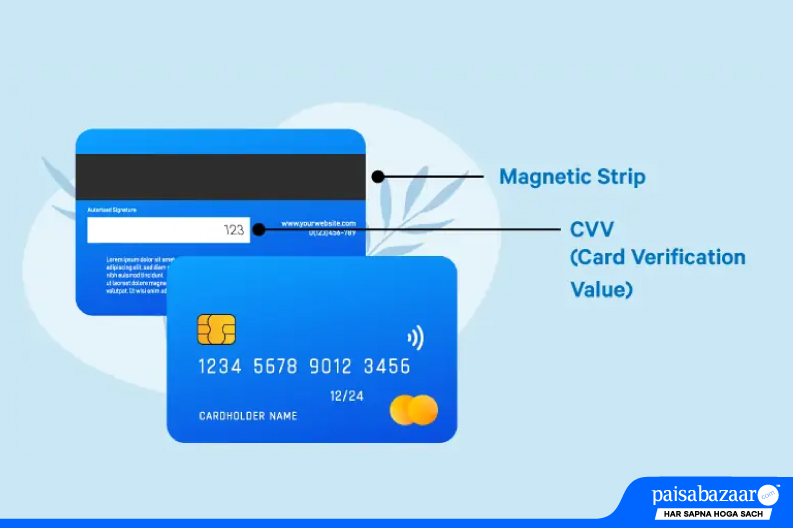
Finding a CVV number on your debit or credit card is simple, as it is printed on the backside of your card in case of Visa, Mastercard and RuPay cards and on front side for American Express cards. You just have to turn your debit card and look for a 3-digit unique number that is printed just below the magnetic strip.
The first 3 or 4 digits of CVV number are hidden by the magnetic strip, leaving only the last three digits visible. These three digits are required to complete any online transaction.
Most people get confused between CVV and debit/credit card PIN. Although, CVV is also required to complete a transaction but this number is different from a PIN. The PIN is sent to your registered mobile number to carry out the transaction, whereas CVV is already printed on the card. Also, PIN can be of four or six digits long, but CVV is usually 3- or 4-digit numbers.
Apart from this, it also provides security to your transactions as only people who have a debit card can complete the transaction. It acts as an added layer of security and protects you against any fraud.
There are two components of a CVV number in debit card, which are mentioned below:
Magnetic Strip: The magnetic strip covers the first part of the CVV number. It contains unique data about your card and whenever your card is swiped at the magnetic reader machine, the information is read on it. This information is unique for every card and hence need not be shared with anyone.
3-digit Code: After covering most of the digits through the magnetic strip, the three visible digits are required to complete a transaction online. You are not required to enter the CVV for offline transactions as the data is read by the POS machine during swiping.
|
Interested in Earning Rewards or Cashback on all your expenses? Check Top Rewards Credit Cards OR Top Cashback Credit Cards in India & Apply Now! |
Exclusive Card Offers from India’s top banks are just a click away
Error: Please enter a valid number
No, you are not required to enter the CVV number for offline transactions. This is because when you swipe your card at the POS machine, the machine reads the data from the magnetic strip along with your debit card number, expiry date and CVV. In such cases, you are only required to enter the OTP/PIN to complete a transaction.
For most of the debit and credit cards with payment networks like Visa, MasterCard, and RuPay, the CVV is a 3-digit number located on the back of the card. However, for American Express cards, the CVV is a 4-digit number printed on the front of the card (back in some cases).
You can find the CVV number on the back of your debit or credit card. In case you want to see your CVV number online, you can check your virtual debit card, available on the mobile banking app or your net banking portal.
Ideally, CVV stands for Card Verification Value. However, it may also be known as Card Security Code (CSC), Card Verification Code (CVC) or Card Identification Number (CID).
A CVV number is a unique 3- or 4-digit identification number for your debit and credit cards. The number is required to complete online transactions, thus, must be declared only on authentic payment platforms. Other than that, it is advisable that you do not declare your CVV code to unidentified payment gateways or agents.
You can find the CVV number on the back side of your credit or debit card. Click here to identify CVV in a debit card or credit card.
No, the CVV number in debit card is printed on its back side, whereas, the PIN is sent to your registered mobile number like an OTP. However, both of these are used to verify and complete the transaction and provide security.
In most of cases, the CVV number is a three-digit number that is printed on the back side of your debit card. This number is unique for every debit or credit card. It could be four digits as well, in some very rare cases.
No, CVV number is allocated and generated by the card provider. It is generated based on your debit/credit card number, card’s expiry date, service code and other factors. The CVV number is also known as Card Security Number (CSN) as it provides security for your online transactions.
Limited Time Offer
 with Every Card
Choose a Card Matching Your Lifestyle
Please enter a valid full name
 +91
+91
The entered number doesn't seem to be correct
