Download the
Paisabazaar app Today!
Paisabazaar app Today!
Get instant access to loans, credit cards, and financial tools — all in one place

Win Assured Cashback

Our Advisors are available 7 days a week, 9:30 am - 6:30 pm to assist you with the best offers or help resolve any queries.


Get instant access to loans, credit cards, and financial tools — all in one place

Scan to download on


 Personal Loan
 Business Loan
 Home Loan
 Other Loans


Our Advisors are available 7 days a week, 9:30 am - 6:30 pm to assist you with the best offers or help resolve any queries.

Do you feel that you are paying a huge chunk from your income on taxes? There are high chances that you do not have an efficient tax plan! A defined tax saving plan can help you benefit from tax exemption and earn tax-free income. The tax-saving season, starting from 1st April, is approaching for both salaried and non-salaried taxpayers. Now is the time when you compare and consider different tax-saving schemes for 2020-21.

A high Credit Score may help you get a credit card with better benefits. Check Now
Here is an overview of the schemes to have a proper understanding of how the returns will be taxed:
| Saving Scheme | Lock-in Period | Returns |
| ELSS | 3 years | 15% to 18% |
| Unit Linked Insurance Plan (ULIP) | 5 years | Returns differ from one plan to another |
| National Pension Scheme (NPS) | Till Retirement | 12% to 14% |
| Public Provident Fund (PPF) | 15 years | 7% to 8% |
| Sukanya Samriddhi Yojana | No lock-in period | 8.5% |
| National Savings Certificate | 5 years | 7% to 8% |
| Bank Fixed Deposits | 5 years | 6% to 7% |
| Insurance | 3 years | Returns differ from one plan to another |
| Senior Citizen Savings Scheme (SCSS) | 5 years | 8.7% |
Read more : Tax Saving Investment under Section 80c
Optimising tax saving helps individuals serve their financial goals. There are different methods and schemes which allow you to save taxes under Section 80(C) of the Income Tax Act 1961.
A maximum of Rs 1,50,000 is exempted from tax when invested in such schemes (under Section 80C). Investors of NPS can avail an additional deduction up to Rs.50,000 under Section 80CCD(1b). Some of the most popular saving schemes with tax benefits are ELSS (Equity Linked Saving Schemes)- a type of mutual fund, Fixed Deposits, Sukanya Samriddhi Yojana, Public Provident Fund, National Saving Schemes, etc.
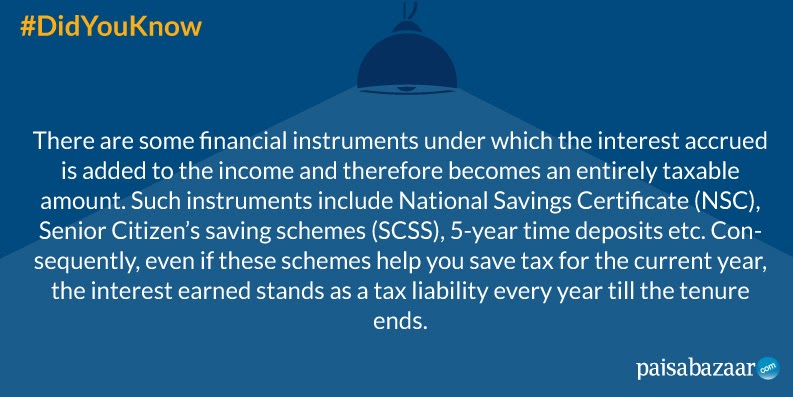
There are certain factors such as Returns, Liquidity and Safety which directly affect your investment strategy. Here are a few ways & strategies which you can depend upon while selecting a suitable saving scheme for tax planning:
Under Section 80(C), ELSS and NPS are the two best market-linked saving schemes as far as returns potential is concerned.
PPF is a suitable option to save taxes if you are looking for long-term investment plans-
Small deposits such as Sukanya Samriddhi Yojana are considered as good options to curb tax cuts. SSY is a scheme specially designed for the girl child. Offering an interest rate of 8.1% and tax exemption benefits, this scheme was introduced under Beti Bachao Beti Padhao campaign.
While choosing a suitable tax-saving scheme, investors are advised to avoid over-diversification in the investment strategy. When investors allocate their corpus into different schemes, they eventually fail to keep a record of the performances. Due to diverse strategies, the returns from 80(C) savings face downfalls.
Plan your Tax-saving investments
It is apparently observed that most of the taxpayers delay their tax planning and end up pestering their financial goals. Tax planning must be carried out at the beginning of the financial year so that the invested amount is able to multiply over a period of time and give desirable returns.
Tax-payers must always check their tax-saving expenses such as insurance premiums, EPF contributions, children’s tuition fees etc. if the total amount of the tax-saving expenses is greater than Rs.1.5 lakh, then you are not required to invest the entire amount. Suitable tax-saving schemes such as PPF, FDs, ELSS, NPS must be chosen after considering the financial goal and risk profile.