Download AppWin Assured Cashback
Paisabazaar Logo - Compare loans and credit cards

Should You Pay Only the Minimum Amount Due on Your Credit Card?

cc-freeAirport Lounge Access
with every credit card
cc-illustration
Compare 100+ Credit Cards

Choose a Card Matching
Your Lifestyle

What Is the Minimum Amount Due on a Credit Card?

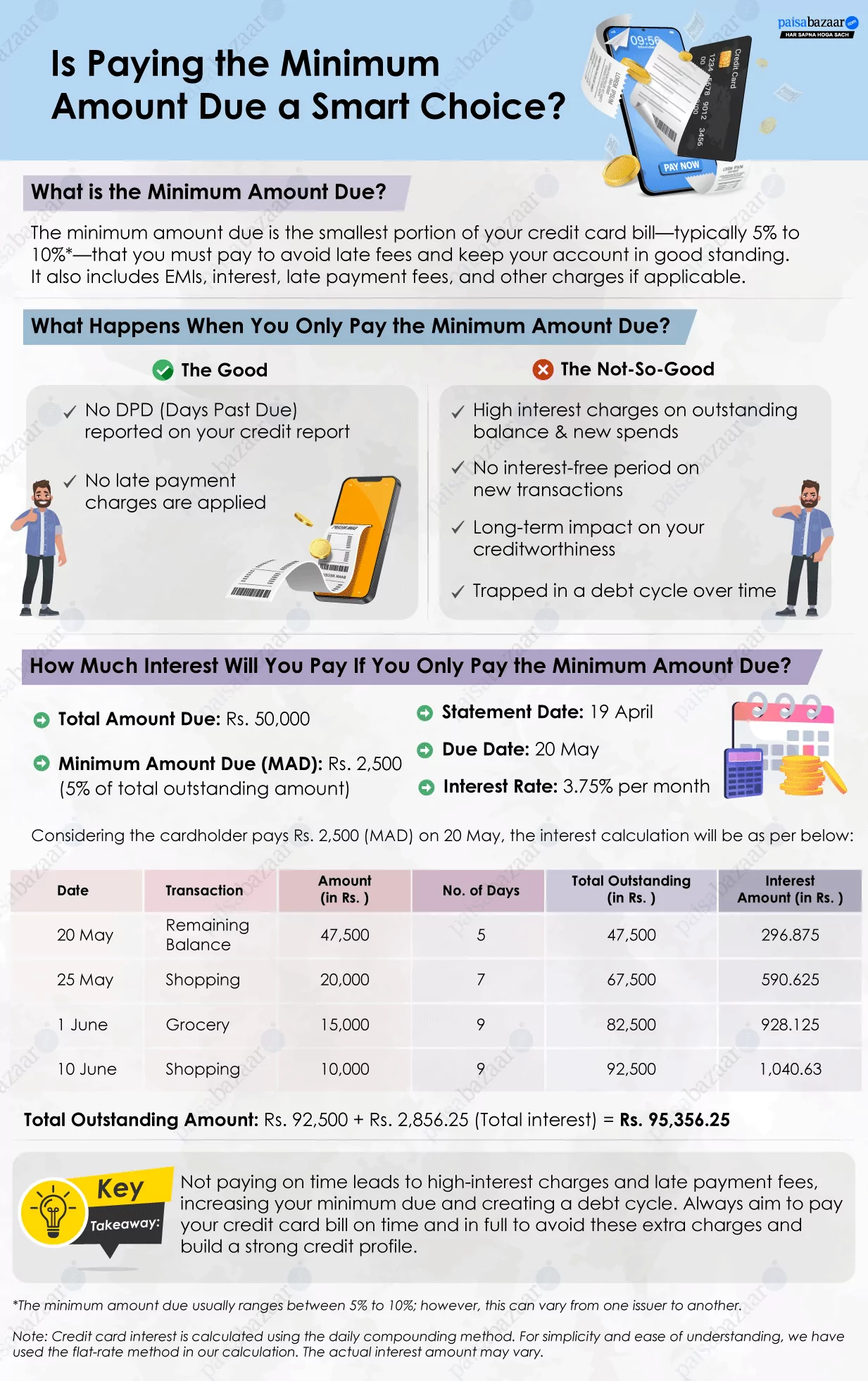
The minimum amount due is the smallest portion of your total outstanding credit card bill that must be paid by the due date to keep your account in good standing and avoid late payment charges. Usually, the minimum due ranges from 5% to 10% of the total outstanding amount, though this percentage may vary from one issuer to another.

One important thing to note is that the minimum amount due includes EMIs, interest, fees, and other charges. So, if you have an ongoing EMI, it will also be added to the monthly minimum amount due.
How Is Minimum Amount Due Calculated?

While calculating the minimum amount due, the following components are considered:

  • EMIs on any converted transactions
  • Any past unpaid minimum dues
  • Interest and other charges
  • Fees (if applicable)

Example 1:

  • Monthly Spends: Rs. 30,000
  • No EMI

Minimum Amount Due: 5% of Rs. 30,000 = Rs. 1,500

Example 2:

  • Monthly Spends: Rs. 30,000
  • EMI Amount: Rs. 5,000

Minimum Amount Due: Rs. 1,500 (5% of Rs. 30,000) + Rs. 5,000 (EMI) = Rs. 6,500

Example 3:

  • Monthly Spends: Rs. 30,000
  • EMI Amount: Rs. 5,000
  • Annual Fee: Rs. 500

Minimum Amount Due: Rs. 1,500 (5% of Rs. 30,000) + Rs. 5,000 (EMI) + Rs. 500 (Annual Fee) = Rs. 7,000

What Happens When You Only Pay the Minimum Amount Due?

  • Paying the minimum amount due keeps your credit card account active and helps avoid late payment fees. However, paying only the minimum due is not a good long-term practice.
  • The unpaid balance is carried forward to the next billing cycle and starts attracting interest charges.
  • Interest is charged not only on the outstanding balance but also on any new purchases made.
  • Paying your credit card bill in full allows you to enjoy an interest-free period of up to 45–55 days (depending on the issuer).
  • If only the minimum amount is paid, the interest-free period is lost.
  • New transactions begin attracting interest from the date of purchase until the entire outstanding amount is cleared.
  • Regularly paying only the minimum due can significantly increase your debt burden due to high interest charges.

What Happens When You Don’t Pay the Minimum Due Amount

Missing bill payments or making partial payments towards your credit card dues is the most common reason why people fall into debt. If you don’t make any payment against your credit card bills, it can lead to late payment charges. Not only do missed payments attract high-interest charges leading to subsequent debt, but they can also damage your credit score, as missed payments are recorded in your credit report’s ‘Days Past Due (DPD)' section. Hence, if you are not able to pay your card bill in full, you should pay at least the minimum amount due or the maximum amount you can repay to maintain a healthy credit profile.

Does Paying Minimum Amount Due Affect Your Credit Score?

While paying the minimum due avoids a negative mark on your credit report, it increases your credit utilization ratio and outstanding balance, both of which can affect your credit score over time. A higher CUR and revolving large balances for a longer period are seen as risky behaviour by lenders, which makes it difficult for you to get approved for better credit cards in the future.

At a Glance: Is Paying the Minimum Amount Due a Smart Choice?

Here’s everything you need to know about the minimum amount due on a credit card—and whether it’s truly a smart financial practice.

Pros & Cons of Paying Minimum Amount Due

Pros Cons
  • Avoids late payment penalties
  • Keeps your account active
  • Maintains credit score in the short term
  • High interest charges on outstanding amount & new transactions
  • No interest-free period on new purchases
  • Negative impact on creditworthiness in the long term
  • Prolonged debt cycle

Conclusion

Paying only the minimum amount due may offer short-term relief, but it can lead to long-term financial stress. It’s always better to pay your credit card bill in full and on time to maintain a good credit profile and avoid high-interest charges. However, if you are not able to pay your credit card bill in full every month, at least paying the minimum helps you avoid late fees and late payment reporting.

side-banner-mobile

FAQs

What exactly is minimum amount due on a credit card?

It’s the smallest amount you must pay before your due date to keep your credit card active and avoid late payment fees. Think of it as the “bare minimum” needed to stay on track—not to clear your debt.

If I pay only the minimum amount, am I clearing my bill?

No. Paying the minimum just keeps you in good standing, but the rest of your bill gets carried forward. That leftover amount starts attracting interest until you fully repay it.

Why does my credit card bill still feel high even after I pay something?

Because interest keeps building on the unpaid balance—and in many cases, even new purchases start getting charged interest immediately. So the bill can slowly grow if only minimum payments are made.

Does paying only the minimum help or hurt my credit score?

It won’t hurt your score immediately, but it’s not ideal long-term. Your outstanding balance stays high, which increases your credit utilization and can make lenders see you as a higher-risk borrower.

What’s the biggest downside of paying only the minimum?

You end up paying a lot more over time. Interest keeps adding up, and it can take much longer to clear your debt—sometimes trapping you in a cycle where the balance barely reduces.

So what’s the best way to handle my credit card bill?

If possible, always pay the full amount due. If not, pay more than the minimum whenever you can. The more you repay upfront, the less interest you’ll end up paying later.

Paisabazaar is a loan aggregator and is authorized to provide services on behalf of its partners

*Applicable for selected customers

Scroll to top