Download the
Paisabazaar app Today!
Paisabazaar app Today!
Get instant access to loans, credit cards, and financial tools — all in one place

Win Assured Cashback

Our Advisors are available 7 days a week, 9:30 am - 6:30 pm to assist you with the best offers or help resolve any queries.


Get instant access to loans, credit cards, and financial tools — all in one place

Scan to download on



 Personal Loan
 Business Loan
 Home Loan
 Other Loans


Our Advisors are available 7 days a week, 9:30 am - 6:30 pm to assist you with the best offers or help resolve any queries.
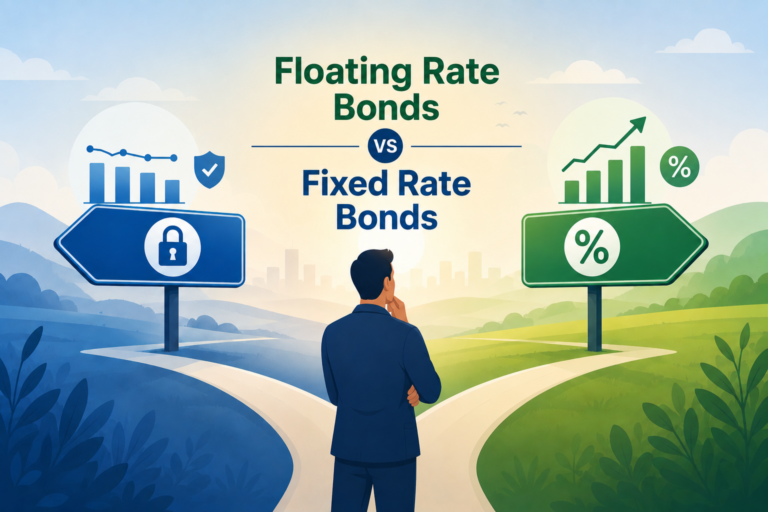
Fixed rate bonds and floating rate bonds are both categories of debt instruments, but they differ significantly in how their returns respond to market conditions. The key difference between them lies in their interest rates: while fixed-rate bonds offer a fixed interest or coupon rate throughout their maturity period, floating-rate bonds adjust their coupon rate periodically based on their linked benchmark rates, protecting against inflation and interest rate risk. Investors should invest in bond based on their investment horizon, risk tolerance and financial goals.
Fixed rate bonds are debt instruments wherein the coupon payments remain fixed or unchanged till the maturity date. Most government bonds are issued as fixed-rate bonds. For instance, Sovereign Gold Bonds (SGBs) are fixed-rate bonds. They provide a fixed coupon rate of 2.50% p.a. on the initial investment amount and interest payments are made at semi-annual intervals.
Floating rate bonds are debt instruments whose coupon rates are revised at periodic intervals. The coupon rates are linked to pre-set benchmark rates like MCLR (Marginal Cost of Funds Based Lending Rate), NSC (National Savings Certificate) rates, repo rate, T-Bill yields, etc. Therefore, the interest payments on these bonds may increase or decrease as per the movements in their linked benchmark rates. Also known as floaters or variable rate bonds, these bonds are issued by both government and companies.
Choosing between fixed and floating rate bonds depends on the investor’s interest rate outlook, financial goals, risk tolerance, and investment horizon.
| Particulars | Fixed Rate Bonds | Floating Rate Bonds |
| Coupon structure | Fixed throughout the maturity period | Benchmark (e.g., repo rate or Treasury bill rate) + Spread |
| When to Invest | During a stable or falling interest rate regime, as high locked-in interest rate becomes valuable | During a rising interest rate regime as coupon interest rate rises when the interest rate rises |
| Who Should Invest | Conservative investors seeking higher income stability or a higher scope of capital appreciation | Return-oriented investors seeking market-aligned interest income or lower volatility in bond prices |
| Investment Horizon | Longer durations as it provides certainty over the long haul. This ensures predictable future cash flows | Short durations, as these bonds are less sensitive to market interest rate fluctuations |