Download AppWin Assured Cashback
Paisabazaar Logo - Compare loans and credit cards

Section 80C of the Income Tax Act (Tax Deduction up to Rs. 1.5 Lakh)

icon
Get Cashback of 500* on Loan Disbursal
Valid till 31st August '26 *T&C Apply
Get Business Loan

Avail up to ₹1 Cr starting at 13%

4.5/5

15.6L Reviews

6cr+Satisfied Customers
30+Lending Partners
₹65k Cr+Loans Disbursed
Icon image of Best Loan Offers

Best Loan Offers

Curated Offers from 20+ Lenders

Icon image of Unsecured Loan

Unsecured Loan

Term Loan & OD Facilities Available

Icon image of Expert Advice

Expert Advice

Guidance & Assistance

Icon image of Top Up Facility

Top Up Facility

Loan to Get Additional Funds

What is Section 80C

Section 80C of the Income Tax Act offers exemptions on specific expenditures and investments from income tax. Any individual or HUF can get a tax deduction up to Rs. 1.5 lakh per financial year under Section 80C of the Income Tax Act and its allied sections such as 80CCC and 80CCD. This deduction is not available to partnerships, companies and other corporate bodies. You have to claim this deduction under Section 80C in your income tax return (ITR) which has to be filed by 31st July each year for individuals.

The amount you claim under this section is reduced from your gross total income for the purposes of computing income tax. For example, if your gross total income is Rs. 10 lakh and you have claimed a deduction of Rs. 1.5 lakh under Section 80C, your taxable income becomes Rs. 8.5 lakh.

Section 80C

Deduction under Section 80C, 80CCC and 80CCD

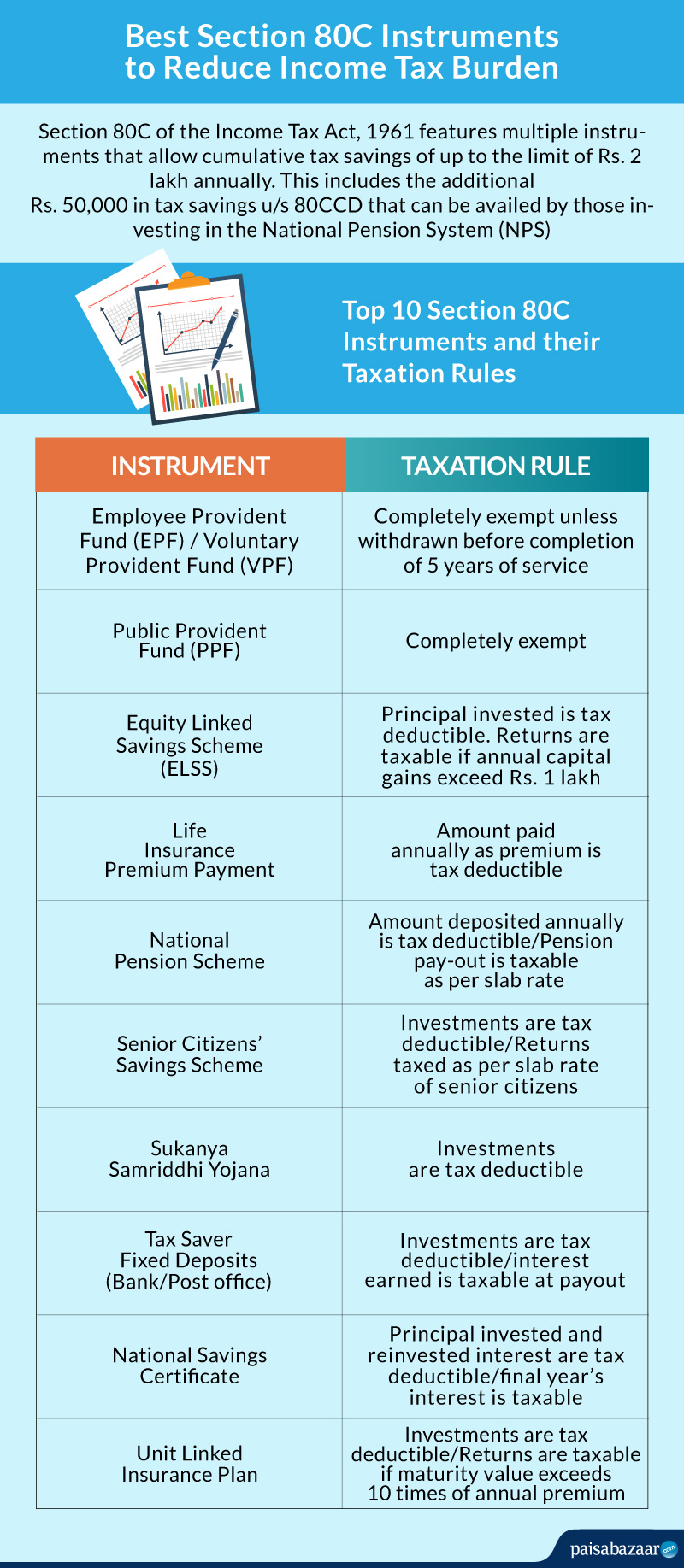
The deduction under this category is available under Sections 80C, 80CCC and 80CCD . Section 80C includes mutual funds, insurance premium tax saver FDs, PPF and several other schemes. 80CCC governs contributions to specific policies which pay a pension or annuity. 80CCD covers contributions to India’s National Pension System (NPS)

Section 80C Limits

The maximum limit for tax saving under Section 80C is Rs. 1.5 lakh. There is no minimum limit.

Section 80C Schemes

    1. Investment Schemes: ELSS Mutual Funds, Unit Linked Insurance Policies (ULIPs)
    2. Insurance Schemes: Term Insurance, Endowment Insurance
    3. Retirement Savings Schemes: Public Provident Fund ( PPF ), Employees Provident Fund , National Pension System (NPS)
    4. Fixed Income Schemes: National Savings Certificate (NSC), Senior Citizens Saving Scheme (SCSS), Sukanya Samriddhi Yojana
    5. Miscellaneous: Home loan repayment , tuition fee payment

Eligibility

An individual or HUF can claim a Section 80C deduction. Companies, Limited Liability Partnerships and other bodies cannot claim this deduction under Section 80C.

The following deductions are available under this section:

1) Life Insurance Premiums either for yourself or family members. However the insurance policy cannot be terminated within two years of commencement if it is a single premium policy. If it is a multiple premium policy, you must pay at least two years’ premiums. Failure to do so will lead to reversal of Section 80C deduction. Unit Linked Life Insurance Policies (ULIPs) are also eligible for deduction under Section 80C.

Tax on Returns: The returns on life insurance policies, where the insurance cover is at least 10 times the annual premium, are exempt from tax under Section 10(10)(D) of the Income Tax Act.

2) Investment in ELSS mutual funds . ELSS mutual funds have a lock-in of 3 years and invest 80% of their corpus in equities (stocks).

Tax on Returns: ELSS returns above Rs. 1 lakh are subject to long term capital gains tax at a rate of 10%.

3) Public Provident Fund (PPF): This is a government savings scheme with a government-administered interest rate. You can invest in it through most banks and post offices. It has a tenure of 15 years.

Tax on Returns: PPF returns are exempt from tax. However, you have to declare PPF returns in your income tax return each year.

4) Employees’ Provident Fund (EPF): Employees’ contribution to the EPF account is eligible for deduction under Section 80C. Employer’s contribution is also tax free but it is not eligible for deduction under Section 80C.

Tax on Returns: EPF interest rate is tax-free. However, it becomes taxable when you leave service at an EPF registered company. The interest also becomes taxable if EPF is withdrawn before completion of 5 years of service with an EPF-registered company.

5) Tax Saving Fixed Deposit: The 5 year tax-saver fixed deposits at banks and post offices are eligible for tax deduction.

Tax on Returns: The interest on such fixed deposits is fully taxable.

6) National Pension System (NPS): The NPS deduction is granted by Section 80CCD (1) and (2).Employer’s and employees’ contributions to the NPS are both tax deductible under Section 80C. However employer’s contributions cannot be more than 10% of your basic salary + dearness allowance, in order to get the benefit of this section. Self-employed person can also claim this benefit for contributions up to 20% of gross income. In addition, voluntary contributions to the NPS up to Rs. 50,000 are exempted over and above Rs. 1.5 lakh under Section 80 C. These voluntary contributions are covered under Section 80CCD (1B).

Tax on Returns: NPS returns are tax-exempt until maturity. At maturity, 40% of the accumulated corpus is tax free.

Read more on NPS – National Pension System Eligibility, Types, Contribution & Charges

7) National Savings Certificate: National Savings Certificates are a government-backed savings instrument with a 5 year tenure. The interest on these certificates is also eligible for tax deduction under Section 80C.

Tax on Returns: Returns on NSCs are also eligible for tax deduction under Section 80C

8) Senior Citizens’ Savings Scheme (SCSS): This is a government-guaranteed savings instrument with a tenure of 5 years which can be extended for an additional 3 years.

Tax on Returns: SCSS returns are fully taxable at your slab rate

9) Sukanya Samriddhi Yojana: This is a government supported savings scheme for the girl child. It can be opened by parents of a girl child who is below the age of 10. The scheme has a tenure of 21 years or until the girl child gets married after the age of 18.

Tax on Returns : Returns on the Sukanya Samriddhi Scheme are tax free.

10) Tuition fees for any school, college or university for up to two children.

11) Home loan repayment

12) Stamp duty/fee for the transfer of house property to yourself

13) Investment in a tax-saver 5 year fixed deposit

Section 80C Investment Options

S no Options Interest Lock-in Period Guaranteed Returns Risk Profile
1 ELSS funds 12-15% (estimated) 3 years No High
2 PPF 7.1% 15 years Yes Low
3 NPS 8-10% (estimated) Till retirement No High
4 NSC 7.7% 5 years Yes Low
5 FD 5.75-9.6% (estimated) 5 years Yes Low
6 ULIP 8-10% (estimated) 5 years No Moderate
7 Sukanya Samriddhi 8.2% 21 years Yes Low
8 SCSS 8.2% 5 years Yes Low

Note: The rates of PPF, NSC, SCSS and Sukanya Samriddhi Yojana are updated as of Q1 FY 2025-26 and are subject to periodic change.

Section 80C Investments for Salaried Employees

The following are key Section 80C tax-saving investment options available for salaried individuals:

  • Public Provident Fund (PPF)
  • Employees’ Provident Fund (EPF)
  • ELSS
  • NPS
  • Tax Saving Fixed Deposits
  • Life Insurance Premium
  • NSC
  • Senior Citizens’ Savings Scheme (SCSS)
  • Sukanya Samriddhi Yojana

Section 80C Tax-Saving Options for Self-Employed Individuals

Given below are the key Section 80C tax-saving investment options for self-employed Individuals:

  • Public Provident Fund (PPF)
  • National Pension Scheme (NPS)
  • National Savings Certificate (NSC)
  • Tax-Saving Fixed Deposits
  • Equity-Linked Savings Scheme (ELSS)
  • Premiums paid for life insurance policies
  • Unit-Linked Insurance Plans (ULIPs)
  • Sukanya Samriddhi Yojana (SSY)
  • Senior Citizens’ Savings Scheme (SCSS)

Section 80C vs Section 80D: What’s the Difference in Tax Benefits

The following are the key differences in tax benefits under Section 80C and Section 80D:

Basis Section 80C Section 80D
Eligible Deductions Offered on expenses and investments made on PPF, ELSS, LIC, NSC, tuition fees, etc. Offers relief on health insurance expenses, such as health insurance premiums and preventive health check-ups
Maximum Deduction Allowed Up to Rs. 1.5 lakh per financial year Rs. 25,000 - Rs. 1,00,000 (based on age and coverage)

Regular Taxpayer

  • Rs. 25,000 for self/family
  • Rs. 25,000 for parents below 60 years of age
  • Rs. 50,000 if parents are senior citizens
Additional Benefit for Senior Citizens Not applicable Senior Citizen Taxpayer

  • Rs. 50,000 for self & family
  • Rs. 50,000 for parents’ insurance

FAQs

Can both resident Indians and NRIs claim deduction under Section 80C?

Yes, both resident Indians and NRIs are eligible for tax deduction under this section.

What is the difference between a tax deduction and tax exemption?

A tax exemption (such as interest on a tax-free bond) cannot be deducted from your gross total income. For example, if you have a gross total income of Rs. 10 lakh and also get interest on tax-free bonds of Rs. 1 lakh per annum, the additional Rs. 1 lakh will not be taxable. However, this amount will not be reduced from your gross total income of Rs. 10 lakh. On the other hand, a tax deduction will be deducted from your gross total income. For example, if your gross total income is Rs. 7 lakh and you have invested Rs. 1.5 lakh in a tax-saving instrument under Section 80C, your taxable income will become Rs. 5.5 lakh.

Is personal accident insurance covered under Section 80c?

Yes, all types of life insurance premiums are covered. This includes personal accident insurance which pays out in case of death due to an accident. However, the insurance cover must be at least 10 times the annual premium.

Is Section 80C applicable in new tax regime?

No, Section 80C deductions are not available under the new tax regime.

Why is Section 80C important for taxpayers?

Section 80C of the Income Tax Act is important because it helps individuals and HUFs claim tax deductions on investments and expenses up to Rs. 1.5 lakh in a financial year. However, this exemption can be claimed only in case of old regime.

Do life insurance premiums qualify for Section 80C deduction?

Yes, you can claim tax deduction on premiums paid on life insurance policies under Section 80C of the Income Tax Act.

Is Public Provident Fund (PPF) covered under Section 80C?

Yes, you can claim a tax deduction up to Rs. 1.5 lakh in a financial year for investments made in PPF, provided you opt for the old tax regime.

Are Equity Linked Savings Schemes (ELSS) eligible for tax deductions?

Yes, ELSS are eligible for tax deductions under Section 80C.

Is tuition fee payment for children covered under Section 80C deductions?

Yes, tuition fee payment for any school, college or university for up to two children is covered under Section 80C deductions.

Do I need to submit proof to claim Section 80C deductions?

You are not required to provide any documentary proofs to the Income Tax Department to obtain Section 80C deductions when filing your ITR. However, it is recommended that you keep these documents safely in case they are required by the tax department or assessment officer later.

Paisabazaar is a loan aggregator and is authorized to provide services on behalf of its partners

*Applicable for selected customers

Scroll to top
Knapsack with coins

Check Best Business Loan Offers
with Quick Disbursal