Download the
Paisabazaar app Today!
Paisabazaar app Today!
Get instant access to loans, credit cards, and financial tools — all in one place

Win Assured Cashback

Our Advisors are available 7 days a week, 9:30 am - 6:30 pm to assist you with the best offers or help resolve any queries.


Get instant access to loans, credit cards, and financial tools — all in one place

Scan to download on



 Personal Loan
 Business Loan
 Home Loan
 Other Loans


Our Advisors are available 7 days a week, 9:30 am - 6:30 pm to assist you with the best offers or help resolve any queries.
Table of Contents
Exchange Traded Fund or ETF is an investment option which invests pooled funds in diversified securities including bonds, equity, commodity, an index or a bouquet of equity assets such as an index fund. The ETF is marketable security in itself i.e it can be traded on stock exchanges similar to the equity stock of companies, unlike mutual funds.
Since exchange-traded funds are listed and traded on bourses, they are prone to price changes as per the value of underlying assets. Another key point of difference between ETF and mutual funds is the fact that ETFs feature a higher degree of liquidity in comparison to mutual funds as they can be bought or sold with greater ease.
Additionally, an ETF also tends to feature significantly lower management fees as compared to mutual funds. Being a market-traded security, ETFs do not have a NAV or Net Asset Value, which is unique to mutual funds. The smallest unit of an ETF is a share, which has a face value and a trading value similar to an equity share.
Because an ETF usually represent a basket of products/assets, this type of investment tends to own the assets underlying the fund. Such assets include but are not limited to company stocks, oil futures, gold, foreign currency, and bonds.
In India, gold and index-linked ETFs are the most common types available to individual investors. Subsequently, the ETF divides the total assets it owns into smaller units termed as shares, which can be traded on the exchange. Thus the current trading value of an ETF is based on the applicable value of net assets that the Exchange Traded Fund owns at that point of time.
For example in the case of a gold ETF which primarily holds gold bullion as the underlying asset, changes in the price of gold will cause a corresponding change in the price of ETF shares during the course of the trading day.
It is, however, important to note that unlike a company share, which denotes part ownership of the equity of the company an investor is invested in, shareholders of an ETF cannot stake a claim of partial ownership to the underlying assets of the exchange traded fund.
However, the shareholders of an ETF are liable to receive profits earned from the underlying assets in the form of dividends or interest earned.
Moreover, in the case of ETF liquidation, the shareholders may also receive a residual value. As mentioned earlier, ETFs can be bought and sold on stock markets just like company shares, hence in layman terms, an ETF may be considered similar to a mutual fund that can be bought and sold on the stock exchange and whose trading value can change in real time.
The first ETF was launched way back in 1993 in the US. Since that time, this investment option has gained great popularity leading to a marked increase in the value of underlying assets held by the ETFs.
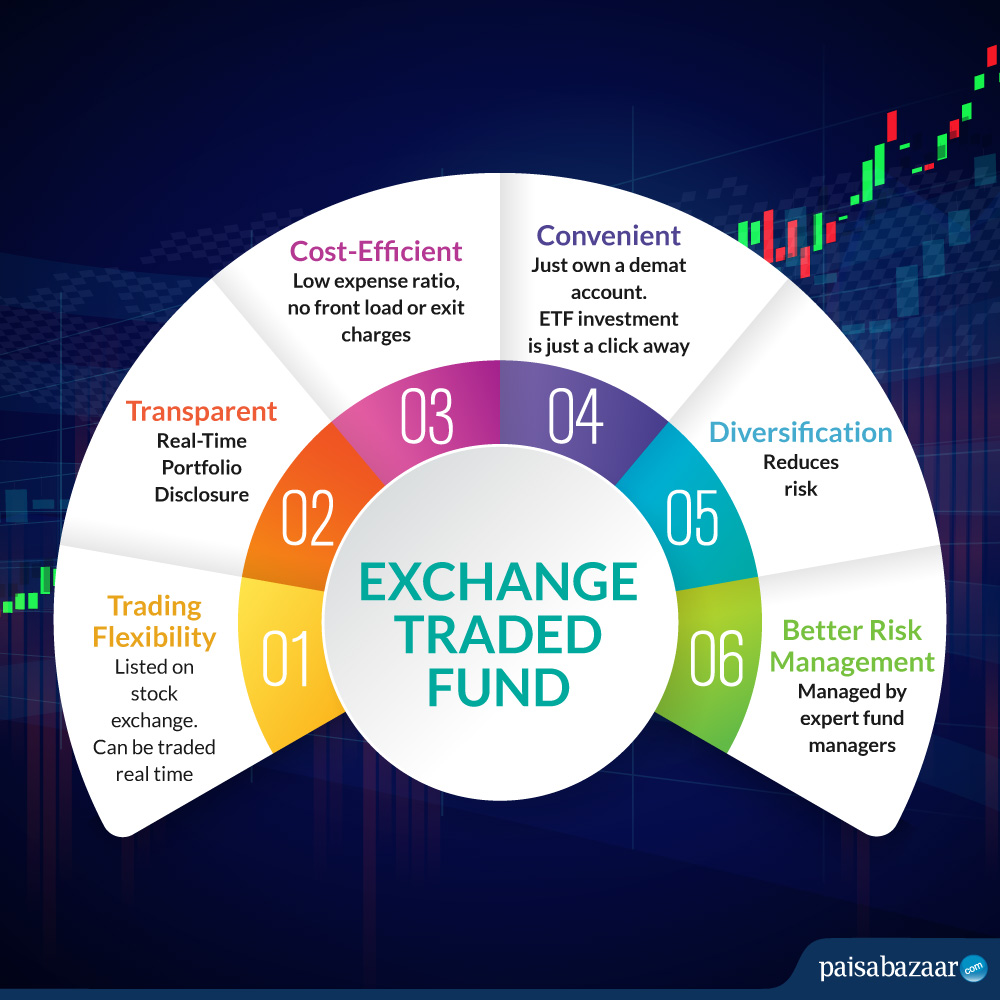 The following are the key reasons why Exchange Traded Funds have gained more and more popularity in recent times:
ETF is a cost-efficient product and often considered unique because of the low expense ratio. A lower fund management fee can generate incremental savings and therefore, increase payouts in the long term.
Diversification is another key benefit that an investor derives from ETF investments. Firstly, one can potentially choose from a wide range of ETFs which mainly differ on the basis of the underlying asset such as gold, equity or index funds. Further, certain ETFs such as an equity ETF will save you from concentration risk as it would invest its funds in a diversified portfolio of equity stocks.
Since ETFs are managed by market experts and best in class fund managers, they come with the advantage of better risk management and therefore, reducing your overall risk exposure. ETFs can also be used for hedging purposes.
Unlike mutual funds, ETFs provide you trading flexibility. You can trade the ETF on a stock exchange just like any other stock. The instant trading feature of ETF makes intraday management of the portfolio easy. ETFs can be purchased at a margin and even sold short. You can channelize your money from bonds to gold to equity in a snap.
The market trading benefit of an ETF extends well beyond the intra-day trade. Some of the other advanced trading techniques that are supported by an exchange traded fund include trading on margin, short selling, and various speculative strategies. Though these are risky bets and not easy to perform successfully, they do provide traders with an opportunity to earn huge profits in a short time.
Despite many advantages, exchange traded funds also suffer from certain limitations which are as follows:
In a majority of cases, ETFs can be bought and sold through registered brokers and broking houses. However, many of these brokers charge the investor for the services offered. Thus the brokerage fee can increase your overall cost of investment in ETF despite low expense ratio. However, you can reduce the cost by engaging with a broker who has lower broker charges.
Volatility risk is often considered to be a packaged deal with investments in market-linked instruments. Thus ETFs being exchange-traded are not completely immune to price volatility, which can impact the value of investments considerably depending upon the direction of the price change. Further, as compared to mutual funds, ETF as an investment product is less diversified especially a gold ETF or index ETF.
Since ETFs are marketable securities which can be traded on stock exchanges, you are required to have a demat account. This could be troublesome for the people who do not want to have direct interactions with the stock markets and don’t have a demat account.
ETF investments are subject to taxes. However, tax rates on gains from ETF investments vary based on the underlying asset of the fund. In case the underlying asset is a commodity such as gold, the taxation rules would be the same as in the case of profits generated from sale or trade of non-equity mutual fund investments. Alternately, if the underlying asset is equity-oriented such as in the case of an Index ETF, taxation rules of equity mutual funds will apply to the ETF.
The equity mutual fund rules of taxation that apply to Index ETFs involve short term and long term capital gains. Profits received from the trade/sale of ETF shares are considered as short term capital gains if the shares were held for less than 1 year from the date of allotment. Short-term capital gains are taxed at the rate of 15% in case of equity-oriented ETF as per current rules.
Long-term capital gains rule in the case of this type of ETF is applicable to shares that have been held for a period of over 1 year from the date of allotment. As per current taxation rules, long-term capital gains in case of equity-oriented investments are taxed at 10%.
Also Read : How Mutual Funds are Taxed?
Non-equity ETFs such as a gold ETF are subject to a different set of short term and long term capital gains rules. Short term gains, in this case, imply profits generated through trade/sale of ETF shares prior to the completion of 3 years from the date of investment.
Such profits are added to the annual income of the investor for the applicable year and taxed according to the applicable slab rate. Shares in ETF that are held for over 3 years from the date of allotment are subject to long-term capital gains rules. At present, non-equity oriented ETF such as a gold ETF is taxed at 10% before indexation and 20% after indexation benefits.
Also Read : Best ETF Funds in India in 2019
| Parameter | ETFs | Mutual Funds |
| Fund Size | Flexible | Fixed/ Flexible |
| Portfolio Disclosure | Real Time | Monthly |
| Intraday Trading | Available | Not Available |
| Diversification | Low to Moderate | Moderate to High |
| Price Volatility | Comparatively High | Comparatively Low |
Exchange Traded Funds might have emerged as an alternative investment route for individual investors and this has also led to a class of mutual funds that exclusively invest in ETFs. The prime example of this is a typical gold fund that primarily invests in one or more gold ETFs.
In such a situation, the gold ETF invests a major portion of its assets in physical gold, while the gold fund buys the share of the gold ETF. For an investor purchasing the gold ETF-based mutual fund is much easier as no DEMAT account is required and a free of cost investment account from Paisabazaar.com can be used to make such a purchase.
Moreover, gold funds are much less prone to volatility as compared to gold ETF, while an increase in the price of gold assets that form the ETF portfolio will push the price of gold funds upwards. Thus many investors have preferred to invest indirectly into gold Exchange Traded Funds through the mutual fund route as compared to investing directly in an Exchange Traded Fund.
Here is a List of Top Exchange Traded Funds (ETF) in India
| ICICI Prudential Banking and Financial Services Fund |
| UTI Sensex ETF |
| Canara Robeco Gold ETF |
| Motilal Oswal Nasdaq 100 ETF |
| Reliance ETF Liquid BeES |
| SBI – ETF Nifty Bank |
| Nippon ETF Bank BeES |
| SBI – ETF Gold |
| Quantum Gold Fund |
| LIC MF ETF – Sensex |
| Nippon ETF Sensex |
| Kotak Sensex ETF |
| Invesco India Nifty ETF |
| SBI – ETF Nifty 50 |
| ABSL Nifty ETF |
| SBI – ETF BSE 100 |
| Nippon ETF Nifty 100 |
| Nippon ETF Infra BeES |
| Nippon ETF NV20 |
| Kotak NV 20 ETF |
| SBI – ETF Nifty Next 50 |
| Nippon ETF Junior BeES |
| Nippon ETF Hang Seng BeES |
| Nippon ETF Consumption |
| Nippon ETF Dividend Opportunities |
| Nippon ETF Liquid BeES |
| IIFL Nifty ETF |
| Reliance Shares Gold ETF |
| Axis Gold ETF |
| Invesco India Gold ETF |
| IDBI Gold Exchange Traded Fund |
| Kotak Gold ETF |
| ICICI Prudential Gold ETF |
| UTI Gold Exchange Traded Fund |
| Nippon ETF Gold BeES |
| SBI – ETF Gold |
| Birla Sun Life Gold ETF (G) |
| HDFC Gold Exchange Traded Fund |
| SBI – ETF Nifty Bank |
| UTI Sensex Exchange Traded Fund |
| HDFC Sensex ETF |
| Nippon ETF Long Term Gilt |
| Nippon ETF Nifty BeES |
| ICICI Prudential Nifty ETF |
| SBI – ETF Nifty 50 |
| UTI Nifty Exchange Traded Fund |
| HDFC Nifty 50 ETF |
| Kotak Nifty ETF |
| IDFC NIFTY ETF |
| SBI-ETF 10Y Gilt |
| ICICI Prudential Nifty 100 ETF |
| SBI – ETF BSE 100 |
| ICICI Prudential NV20 ETF |
| SBI – ETF Nifty Next 50 |
| ICICI Pru Midcap Select ETF |
| Nippon ETF PSU Bank BeES |
Q1: What types of ETFs are present in India?
Ans. Exchange Traded Funds are classified on the basis of the type of the underlying asset that the ETF is holding. At present, there are three types of ETF in India.
Q2: Who can invest in ETFs?
Ans. Following Categories for investment in ETFs:
Q3: What are the benefits of investing in the ETF?
Ans. Exchange Traded Funds operate like mutual funds only but since ETFs can be listed and traded on stock exchanges, they come with the added advantage of real-time trading flexibility. Apart from that ETFs also provide other benefits such as transparency, lower expense ratio, diversification of portfolio and better risk management.
Q.4: What are the costs of investing in ETFs through the exchange?
Ans: Exchange Traded Funds are bought on their real-time cost on the stock exchange. You can buy it from the stock exchange or through a stock broker. Thereby, brokerage is paid every time an investor buys or sells funds. Moreover, the cost of an ETF also involves the usual costs of trading and securities transaction tax. As compared to Mutual Funds, ETFs do not charge a load. The expense ratio is also quite low as compared to mutual funds. Besides this, there is a third cost involved which is bid/ask spread- Ask is the market price at which an ETF can be bought and Bid is the market price at which it can be sold.
Q.5: How do ETFs derive their liquidity?
Ans: There are two steps in which an ETF derives its liquidity. Firstly, it derives the liquidity from the trading of the units in the secondary market which means the demand and supply of units. Secondly, the shares that can be created and redeemed in the primary market. It is important to analyse the underlying securities to assess the overall liquidity rather than solely relying on the trading volume.
Q.6: What are the advantages of ETFs over normal open-ended mutual funds?
Ans: If you invest in an ETF, you will be able to enjoy the following benefits which are otherwise not available in case of normal open-ended funds:
Q.7: What are the differences between a closed-ended mutual fund and an ETF?
Ans: Here are some points to derive the difference between Close-ended funds and ETFs:
Q.8: Who should invest in an ETF?
Ans: Exchange Traded Funds (ETFs) are suitable for the following investors-
Q.9: What is Tracking error in an ETF?
Ans: Tracking error is basically the difference between the portfolio returns of an ETF and the returns from the benchmark or index fund which it was meant to mimic or outperform.