


Systematic Investment Plans (SIPs) have made mutual fund investments in India simple and convenient for millions of investors. For decades, monthly SIPs have been a popular choice, allowing investors to automate fixed investments every month. However, to make mutual funds accessible to more people, options like daily SIPs have emerged as an alternative to monthly SIPs, enabling investors to invest smaller amounts, as low as Rs 10 a day, instead of making a single and bigger monthly contribution. But, which SIP frequency should you choose, daily SIP or monthly SIP? Let’s find out.
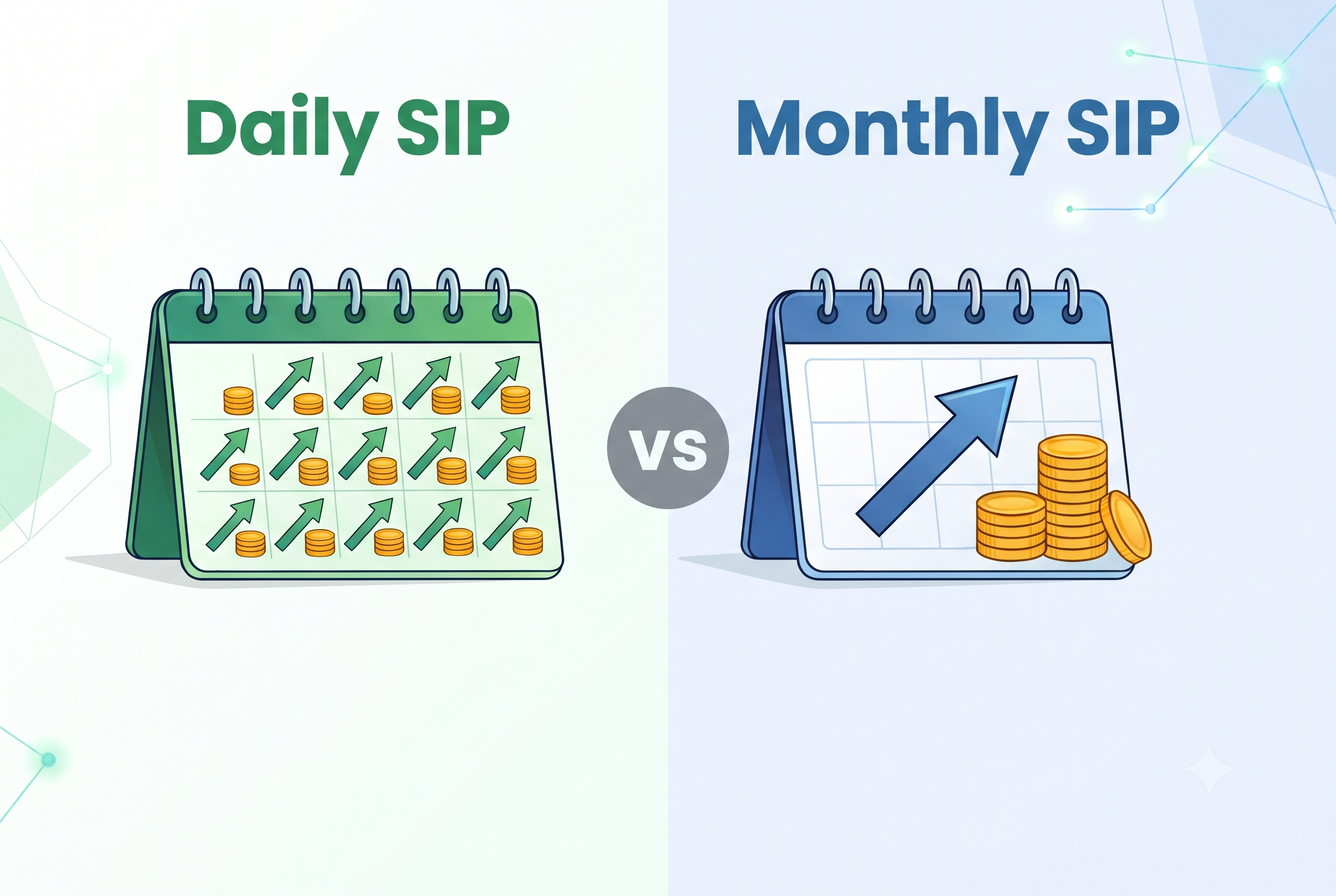
Between Daily and Monthly SIPs: Which is Better?
To see whether investing once a month versus every day actually makes a difference to your final corpus, we compared them based on the Nifty 50 index between December 1, 2010 to December 1, 2025. We fixed the ‘total amount invested’ so that irrespective of investment frequently, the total money invested remains the same. Here’s how the structure goes:
In daily SIP, Rs 1,000 was invested everyday, adding up to 3,719 installments over a period of 15 years. For monthly SIP, the amount was adjusted to Rs 20,547 across 181 installments. The investment rhythm changes dramatically, but the total money invested stays the same.
| SIP Frequency | Daily SIP | Monthly SIP |
| SIP Installment Amount | Rs 1,000 | Rs 20,547 |
| Total no. of Installments | 3,719 | 181 |
| Total Amount Invested | Rs 37.19 lakh | Rs 37.19 lakh |
| Current Valuation | Rs 1.15 crore | Rs 1.14 crore |
| XIRR | 13.83% | 13.80% |
| Investment Universe | Nifty50 | Nifty50 |
Note: The XIRR has been calculated for SIP investments in the Nifty50 from 01-Dec-2010 to 01-Dec-2025. SIP amounts have been selected such that the total investment remains the same across all three frequencies, enabling a like-to-like comparison.
Result: In final results, the daily SIP grows to about Rs 1.15 crore with an XIRR of 13.83% and the monthly SIP ends slightly lower at Rs 1.14 crore, delivering returns at 13.80%. So, even though the money goes in at very different intervals, the long-term returns barely move. While daily SIPs may appear marginally ahead in the example but the difference is negligible to even matter.
Thus, over a long-term, the investment discipline and horizon matters more than how often you invest. The actual factor broadly influencing your returns is:
- how long the money stays in the market for compounding, and
- how the fund performs over a period of time.
Not whether the investments happen daily or monthly.
SIPs work primarily because they build discipline and keep investors invested. Once that discipline is in place, increasing frequency does not improve outcomes.
Also Read: Bonds Investment in India
So, which is the best SIP frequency?
When returns are nearly the same, the right choice would depend on a few practical factors that are specific to investors:
Income pattern
For salaried individuals, monthly SIPs are a better pick because they align well with the single, predictable monthly salary credit, making it easier to plan cash flow and make investment right after the salary credits in your bank account.
If you earn on a daily basis or the income is irregular such as in case of self-employed professionals and non professionals like freelancers, gig workers, etc., a daily SIP would be a more appropriate choice as then it would match with how money actually flows into your bank account, making it easier to stay consistent with your investments.
Affordability
How much money you can invest at a time also matters when making a choice between monthly and daily SIPs. Daily SIPs work well for small, spread-out amounts, i.e., ₹10 a day, which is useful if you want to start investing without committing a large sum upfront. To see how your own daily SIP contributions could grow, try a daily SIP calculator to project your corpus based on your investment amount and tenure. Using this online tool, compare different investment scenarios and determine what works best for your financial goals.
Monthly SIPs, on the other hand, suit those who prefer investing a set, larger amount at once, usually ₹500 and above, depending on the AMC and the mutual fund type. To determine your monthly SIP amount based on your investment goal, use an online SIP calculator. The tool is easy for anyone to use and helps investors determine the ideal investment horizon and monthly SIP amount to reach your investment goal.
Market volatility
As compared to monthly SIPs, daily SIPs create more NAV purchase points, which can even out the impact of short-term market swings, which is a great plus point especially when you are investing during a particularly volatile phase.
Tracking
In monthly SIPs, you make one transaction every month, which gives you one NAV purchase point and one entry to check each month, making it easier to track. Whereas in daily SIPs, each daily instalment is created as a separate investment, which can make it harder for some investors to track their investments. Frequent transactions also complicate the calculation of capital gains when you want to redeem your investment.
Discipline and convenience
Some investors are comfortable with making one monthly debit. Others prefer the psychological ease of smaller daily debits that don't feel like a big monthly outgo. This is a personal comfort factor as much as a financial one. Daily SIPs also require consistent fund availability in the bank account as the transactions happen on a daily basis. Monthly SIPs avoid this issue since you can align the SIP debit date with your salary credit, reducing the risk of missed payments due to insufficient balance in your bank account.
Also Read: Sovereign Gold Bonds Investment
Conclusion
Both daily and monthly SIP approaches have their pros and cons. So the final choice would depend on your income pattern, current financial situation, affordability, etc. Whichever SIP frequency you choose, staying disciplined and consistent with your mutual funds investments and for a long term is what actually drives the SIP returns over time.


