Download the
Paisabazaar app Today!
Paisabazaar app Today!
Get instant access to loans, credit cards, and financial tools — all in one place

Win Assured Cashback

Our Advisors are available 7 days a week, 9:30 am - 6:30 pm to assist you with the best offers or help resolve any queries.

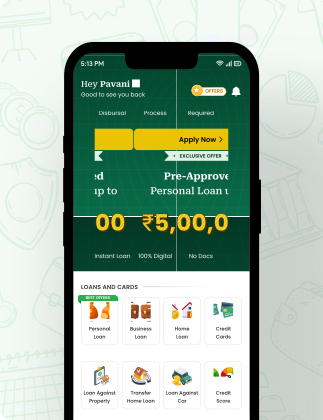
Get instant access to loans, credit cards, and financial tools — all in one place

Scan to download on


 Personal Loan
 Business Loan
 Home Loan
 Other Loans


Our Advisors are available 7 days a week, 9:30 am - 6:30 pm to assist you with the best offers or help resolve any queries.

In the era of development and innovation, entrepreneurship is the latest craze and India is not far behind in the race. Business, especially with new entrepreneurs is quite a fad and fast growing as well. Hence, comes the need for funding the business and its growth with loans!
Business Loans are quite a common phenomenon especially for small and medium scale enterprises. Most of the major banks in India extend business loans to proprietorship firms, partnership firms and private limited and public limited companies. Thus businesses can be funded up to the sanctioned amount through the loans and the features of all such loans are quite similar in nature but yet they differ in terms of interest rates, tenure, etc. across banks and NBFCs.
Most banks and other prominent NBFCs have quite a stringent procedure to offer business loan with detailed documentation required, especially if it is not covered by collaterals. Thus, the smaller and relatively newer businesses suffer the most in this regard. There is, however, a method of small businesses to apply for collateral-free loans through CGTMSE, i.e. Credit Guarantee Fund Trust (CGTSME) for Micro and Small Enterprises (MSEs) for up to Rs 1 crore.
Also Read: How to get a collateral free loan for your startup business?
CGTMSE has been set up by the Ministry of Micro, Small & Medium Enterprises (MSME) to support first generation entrepreneurs by offering Credit Guarantee Scheme based on project viability and credit rating of the promoters, proprietor etc.. The credit guarantee scheme is available for up to 75%-80% of the sanctioned amount such that it would be payable in case the business is declared NPA or non-performing assets.
Here are some of them penned down one by one, in no particular order.
Credit rating is an evaluation of the credit worthiness of a debtor, especially a business (company) or a government, but not individual consumers. The rating is done by a credit rating agency such as CRISIL and ICRA on the debtor’s ability to repay the loan amount which is usually based on personal credit history with personal or home loans, credit card payments, etc. This is done to evaluate the likelihood of loan default.
Collaterals are most commonly seen as real property, business inventory, cash savings or deposits, vehicles and equipment.
Thus, depending upon the factors and the business viability as analysed by the project analyst along with the papers submitted and the onsite report of the credit manager, the amount of loan disbursal is determined.
Last but not the least, collateral is the easiest way to fund a loan as it becomes a secured loan as against an unsecured one without collateral like personal loan. The collateral can be provided on a personal guarantee by the promoters of the company or the sole proprietor to avail the loan and the banks find it much easier to provide and sanction the same as it becomes a secured loan with collateral.
Collaterals are most commonly seen as real property, business inventory, cash savings or deposits, vehicles and equipment.
Also Read: What are Unsecured Business Loans?
Thus, depending upon the factors and the business viability as analysed by the project analyst along with the papers submitted and the onsite report of the credit manager, the amount of loan disbursal is determined.
You May be interested in:
| 21 Best Small Business Ideas you can start today |
| What is Working Capital Loan? |
| Know About Pradhan Mantri Mudra Yojana Scheme |
| What is Commercial loan & How Do They Work? |