Download the
Paisabazaar app Today!
Paisabazaar app Today!
Get instant access to loans, credit cards, and financial tools — all in one place

Get the app — instant card and loan offers!

Our Advisors are available 7 days a week, 9:30 am - 6:30 pm to assist you with the best offers or help resolve any queries.

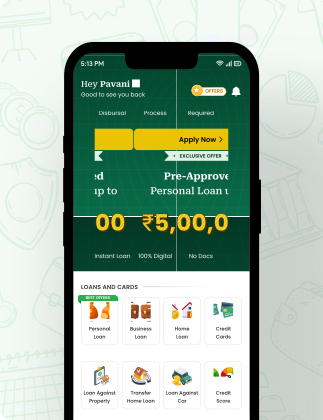
Get instant access to loans, credit cards, and financial tools — all in one place

Scan to download on


 Personal Loan
 Business Loan
 Home Loan
 Other Loans


Our Advisors are available 7 days a week, 9:30 am - 6:30 pm to assist you with the best offers or help resolve any queries.

Import and export are always considered as the two sides of a coin, as they fall under the same umbrella but the processes remain different. Import export business is basically buying and selling goods and commodities between domestic and international enterprises.
Table of Contents :
Imports are goods and commodities purchased from foreign country to be used in native country, whereas exports are goods and commodities produced in the home country; to be sold to markets in foreign countries. Further discussed are some important steps to be taken by the business owner to start an import export business in India.
To start an import export business, the business owner should have a similar business background. He/she should have a basic understanding of global finance and international relations. This shall help the entrepreneur in dealing with suppliers to sell or buy products. There should be thorough research to be performed on import and export business like knowing the tariffs, duties and rules and regulations of countries; to make future export or import relations with.
The priority task before business registration is creating a business plan that shall consist of all the necessary details of the business. After creating the business plan, business owners can apply for company registration under the Ministry of Corporate Affairs (MCA), as private limited or public limited company, sole proprietorship, partnership firm, limited liability partnership, etc.
Secondly, business owner needs to obtain a GST and Service Tax registration certificate. Next step is obtaining the Import Export Code (IEC) that is issued by the Government of India. After getting IEC, business owner needs to get Registration-cum-Membership-Certificate (RCMC) that is granted by any Export Promotion Council of India.
The first thing after legalising the business is to finalize the type of goods or commodities; the applicant needs to export or import. Market identification is equally important to trade like choosing a favourable country for business and considering related opportunities to explore. Next thing is to co-relate whether the chosen product is in demand in that country or not. If not, then changing either of two will be the only viable option.
After finalizing the product to be sold for international trade (export), business owners need to find suppliers, local manufacturers or producers of that particular product to make the business owner lead his/her export business ahead with foreign company. Entrepreneur also needs to understand his/her buyer that could be from these entities like wholesalers, consumers, retailers, manufacturers, governments, or another international body.
The pricing of the products should be inclusive of the mark-up from the base price of the products purchased from the supplier or local manufacturer. Like a supplier has already included his/her commission in the pricing on the products sold, the same way business owner also needs to keep the margin or commission of at least 10% – 15% before selling it to the customers. The margin percentage or commission shall vary from trader to trader and also depend on the type of goods and commodities.
The most complex job out of all in this business is to transport goods or commodities manufactured at a particular location and selling it to some other International location. For this purpose, a business owner needs to hire a global freight forwarder, as it serves as a transport agent for moving goods and minimising burden and tension. Freight forwarders will themselves arrange shipping documents, insurances, tariffs, licenses and permits required for trading in the international market.
* IEC refers to the import-export license issued by the Government of India. It is a 10-digit code issued by the Director-General of Foreign Trade (DGFT), Department of Commerce.
Imports |
Exports |
| Crude Petroleum | Pearls & Precious and Semi-Precious Stones |
| Gold | Mineral Fuels including Oil |
| Pearls & Precious and Semi-Precious Stones and Jewellery Items | Vehicles, Parts and Accessories |
| Electrical Machinery and Equipment | Machinery including Computers |
| Nuclear Reactors, Boilers, Machinery and Mechanical Appliances | Pharmaceuticals |
| Organic Chemicals | Electrical Machinery, Equipment |
| Plastics, Plastic Articles | Iron Steel |
| Chemical Fertilizers | Clothing and Accessories |
Imports |
Exports |
| China | United States of America |
| United Arab Emirates | United Arab Emirates |
| United States of America | China |
| Iraq | Hong Kong |
| Saudi Arabia | Germany |
| Hong Kong | United Kingdom |
| Singapore | Singapore |
| Indonesia | Bangladesh |
| Russia | Malaysia |
| Japan | Nepal |
To start an import export business, entrepreneurs sometimes do require additional capital to invest besides what they have kept as their budget. As this trade happens across the nation’s borders, therefore some specific business loans, lending products or credit lines can only be availed. Below mentioned is a list of business loans that can be availed to start an import export business in India:
Each of these loan products have different features and unique benefits that can be availed to start a new business. Every financial institution has to offer something new and better for their customers. However, not every lender is specialised in offering all of these loan products. Hence, the best way is by visiting paisabazaar.com to check and compare from all these lending products or credit lines offered by popular banks/NBFCs and choosing the best among all.