Download the
Paisabazaar app Today!
Paisabazaar app Today!
Get instant access to loans, credit cards, and financial tools — all in one place

Win Assured Cashback

Our Advisors are available 7 days a week, 9:30 am - 6:30 pm to assist you with the best offers or help resolve any queries.


Get instant access to loans, credit cards, and financial tools — all in one place

Scan to download on



 Personal Loan
 Business Loan
 Home Loan
 Other Loans


Our Advisors are available 7 days a week, 9:30 am - 6:30 pm to assist you with the best offers or help resolve any queries.
Table of Contents :
A systematic withdrawal plan (SWP) is a facility which allows you to withdraw a fixed amount from your mutual fund at regular periodic intervals. The periodic intervals could be monthly, quarterly, half-yearly or annually, as per the investor’s requirement. With every withdrawal, the value of your investment in the fund is reduced by the market value of the units you have withdrawn as the withdrawal happens at that day’s NAV (Net Asset Value).

Get Your Free Credit Report with Monthly Updates Check Now
Let us understand this with the help of an example. Suppose Mr. X purchased 1,000 units of a mutual fund scheme for Rs. 1 lakh in January 2018. And, withdrew Rs. 1,000 per month for 4 months starting February 2018 via a systematic withdrawal plan.
| Month | Cashflows | NAV | No. of units redeemed | Fund Units | Investment Value |
| January | Rs.1,00,000 | 100 | 0 | 1,000 | Rs.1,00,000 |
| February | -10,000 | 103 | 97 | 903 | Rs. 93,009 |
| March | -10,000 | 102 | 98 | 805 | Rs. 82,110 |
| April | -10,000 | 105 | 95 | 710 | Rs. 74,550 |
| May | -10,000 | 106 | 94 | 616 | Rs. 65,296 |
So, by the end of May, Mr. X has withdrawn Rs. 40,000 total via SWP and owns an investment worth Rs. 65,296.
Also Check: Best Mutual Funds for Systematic Withdrawal Plans (SWPs)
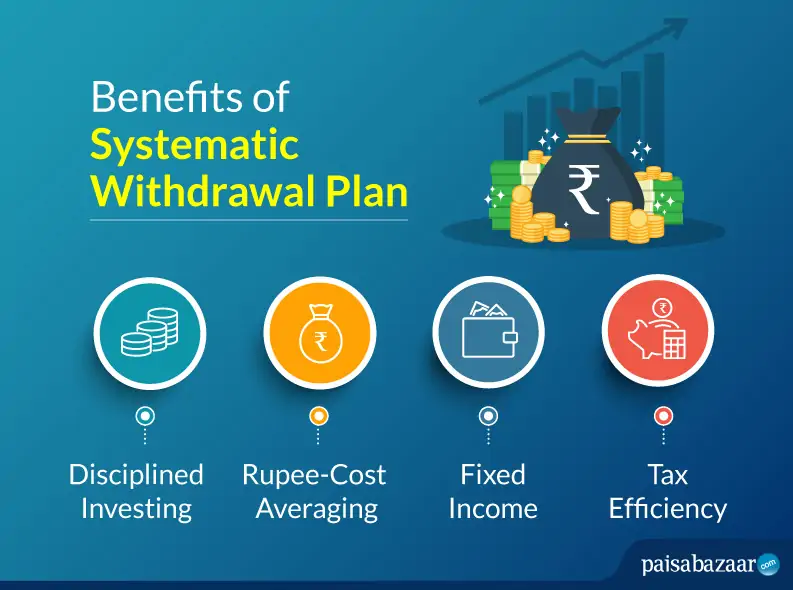
1. Disciplined Investing
An SWP automatically redeems some mutual fund units every month to meet your monthly expenses, regardless of market levels. It thus, protects you from withdrawing large amounts due to panic/fear during the times of market corrections. It also withdraws money even when markets are registering new highs and thus, protects you from the impulse to invest more money during boom periods.
2. Rupee-Cost Averaging
SWPs help investors benefit when they withdraw their investments due to rupee cost averaging. Rupee cost averaging gives an investor the average NAV of a mutual fund over several months/years rather than making him dependant on a NAV at a single point of time.
Here is an example. An investor invested Rs. 1 lakh in a mutual fund scheme in the month of January 2019 at a NAV of Rs. 100. He opted for a lump sum withdrawal at the end of 5 months. Another investor bought mutual funds worth the same amount opted for a monthly SWP of Rs. 10,000 for 5 months. Here is how their investment values pan out:
Lump Sum Withdrawal Vs SWP
Your Credit Score Is Now Absolutely Free Check Report
| Month | Cashflows | NAV | No. of units redeemed | Fund Units | Value of Fund |
| January | Rs.1,00,000 | 100 | – | 1,000 | Rs.1,00,000 |
| February | – | 103 | – | 1,000 | Rs. 1,03,000 |
| March | – | 102 | – | 1,000 | Rs. 1,02,000 |
| April | – | 105 | – | 1,000 | Rs. 1,05,000 |
| May | – | 106 | – | 1,000 | Rs. 1,06,000 |
| June | -Rs. 50,000 | 104 | 481 | 519 | Rs. 53,976 |
| Month | Cashflows | NAV | No. of units redeemed | Fund Units | Value of Fund |
| January | Rs.1,00,000 | 100 | 0 | 1,000 | Rs.1,00,000 |
| February | -Rs. 10,000 | 103 | 97 | 903 | Rs. 93,009 |
| March | -Rs. 10,000 | 102 | 98 | 805 | Rs. 82,110 |
| April | -Rs. 10,000 | 105 | 95 | 710 | Rs. 74,550 |
| May | -Rs. 10,000 | 106 | 94 | 616 | Rs. 65, 296 |
| June | -Rs. 10,000 | 104 | 96 | 520 | Rs. 54,080 |
*The table is based on hypothetical data.
The above tables show how an investor benefits if he/she chooses to withdraw via SWP rather than withdrawing a lump-sum amount as the former option renders the benefit of rupee-cost averaging. The phased withdrawal gives him monthly cash-flows and gives his money a longer period to grow.
3. Fixed Income
A SWP helps an investor get a fixed periodic amount which can help him/her get a steady income in his/her retirement years or managing his/her child’s educational expenses.
4. Tax Efficiency
Each withdrawal made through an SWP is considered to be a combination of capital and income. Tax is only payable on the income component and not the capital component.
For example, assume that Mr A has invested Rs 10 lakh in a mutual fund and this grows to Rs 11 lakh (10% growth). He withdraws Rs 1 lakh from his mutual fund at the end of each year. Only 10% of his withdrawal (Rs 10,000) is considered as income and the balance (Rs 90,000) is considered as capital withdrawal. On the other hand, if he had invested in a bank FD and got Rs 1 lakh interest on a principal of Rs 10 lakh, the entire Rs 1 lakh would be considered as income and would be taxable.
A SWP can also prove to be more tax efficient because if it splits your income over several years. For example, both Mr. X’s and Mr. Y’s total taxable income for FY19 and FY20 is Rs. 4,50,000 without accounting for their mutual fund capital gains. For simplicity, let’s assume the debt mutual fund scheme in which both Mr. X and Mr. Y invested earned monthly gains of Rs. 10,000 throughout FY19 and FY20. While Mr. X chose to opt for a monthly SWP and withdrew the capital gain for 10 months starting October 2018, Mr. Y chose to withdraw Rs. 1,00,000 in July 2019.
Now, due to SWP, Mr. X was able to keep his total taxable income within the tax slab of Rs. 5,00,000 (Rs. 4,50,000 + Rs. 50,000) and pay his tax @ 5% for both FY19 and FY20. Whereas, due to the lump sum withdrawal in July 2019, Mr. Y’s total taxable income increased to Rs. 5,50,000 in FY20, thereby attracting tax @ 20%.
Here is a List of Top Performing Mutual Funds you can Invest in FY 2020:
| Fund Name | 1 Year Return | 3 Year Return |
| Axis Bluechip Fund – Direct Plan | 22% | 21% |
| Mirae Asset Tax Saver Fund – Direct Plan | 18% | 20% |
| Axis Midcap Fund – Direct Plan | 18% | 19% |
| Axis Bluechip Fund – Growth | 21% | 19% |
| Axis Long Term Equity Fund – Direct Plan | 18% | 18% |
| Invesco India Growth Opportunities Fund – Direct Plan | 14% | 18% |
| Axis Midcap Fund – Growth | 16% | 18% |
| Mirae Asset Tax Saver Fund – Regular Plan | 16% | 18% |
| Mirae Asset Emerging Bluechip Fund – Growth | 16% | 17% |
| Kotak India EQ Contra Fund – Direct Plan | 14% | 17% |
Data as on 08th December 2019: Source- Value Research)
