Download the
Paisabazaar app Today!
Paisabazaar app Today!
Get instant access to loans, credit cards, and financial tools — all in one place

Win Assured Cashback

Our Advisors are available 7 days a week, 9:30 am - 6:30 pm to assist you with the best offers or help resolve any queries.


Get instant access to loans, credit cards, and financial tools — all in one place

Scan to download on



 Personal Loan
 Business Loan
 Home Loan
 Other Loans


Our Advisors are available 7 days a week, 9:30 am - 6:30 pm to assist you with the best offers or help resolve any queries.
600 or 750? What's your credit
score? Check for FREE.


Let’s Get Started
 +91
+91
The entered number doesn't seem to be correct
Note: The information on this page may not be updated. For latest updates, click here.
It is mandatory to file Income Tax Returns for individuals with an income over Rs. 2.5 lakh for those below 60 years of age, Rs. 3 lakh in case of people over 60 years old but less than 80 years old and Rs. 5 lakh for those over 80 years of age. These exemption limits keep changing from time to time, depending on the government policies and notifications.
Also, the process for filing the returns is quite simple. One just needs to be aware of the different kinds of ITR forms, their applicability and some commonly used terms. The article discusses key details relating to ITR-1 Sahaj Form, its eligibility and applicability, documentation requirement, structure and more.
Table of Contents :
Form ITR-1 or “Sahaj” (derived from the Hindi word meaning “easy”) is the most commonly used form for filing Income Tax Returns. ITR-1 form is for resident individuals whose total income does not exceed Rs. 50 lakh during the financial year. It is primarily used by salaried individuals. However, there are certain categories of salaried individuals who need to submit their returns through other forms like ITR or ITR-2A.

Get FREE Credit Report from Multiple Credit Bureaus Check Now
ITR-1 Sahaj Form can be used by resident individuals who:
ITR-1 Sahaj Form cannot be filed by the following individuals:
A smart taxpayer should keep the following documents handy while filling the ITR-1 Form. This will not only simplify the process but also expedite it.
Get FREE Credit Report from Multiple Credit Bureaus Check Now
For downloading ITR-1 Sahaj Form, a taxpayer needs to follow the below mentioned steps:
Step 1: Visit the Income Tax Department website and click on “Downloads”
Step 2: Click on “Income Tax Returns”
Step 3: Choose your Assessment Year and click on “Utility” under Common Offline Utility
Step 4: Extract the downloaded file and fill in the details
| Category of Taxpayer | Due Date for Tax Filing |
| Companies excluding those required to furnish a report in Form No. 3CEB under section 92E | 31st October |
| Any person (corporate/non-corporate) who is required to furnish a report in Form No. 3CEB under section 92E | 30th November |
| Any person (other than a company) whose accounts require audit | 31st October |
| A working partner of a firm whose accounts require audit | 31st October |
| Any other assessee | 31st July |
Taxpayers need to submit the duly completed Form ITR-1 by 31st July of the assessment year to file taxes for the previous year. For example, if the income was earned anytime between April 1, 2021 and March 31, 2022, the assessment year for the same would be 2022-23. In this case, the ITR-1 Form needs to be submitted on or before 31st July, 2022.
In case the taxpayer fails to complete the tax return formality within these timelines, he/she can file a “Belated Return” any time before 31st March, 2023. However, late filing attracts penalty. From April 1, 2018, the Government of India introduced the change of imposing fine for late filing of ITR. If the return is filed 3 months before the end of the relevant assessment year or before the assessment completion (whichever is earlier), a late filing penalty of Rs. 5,000 shall be payable. However, in case the income of the person is not more than Rs. 5 lakh, the maximum late filing fee to be paid is limited to Rs 1,000.
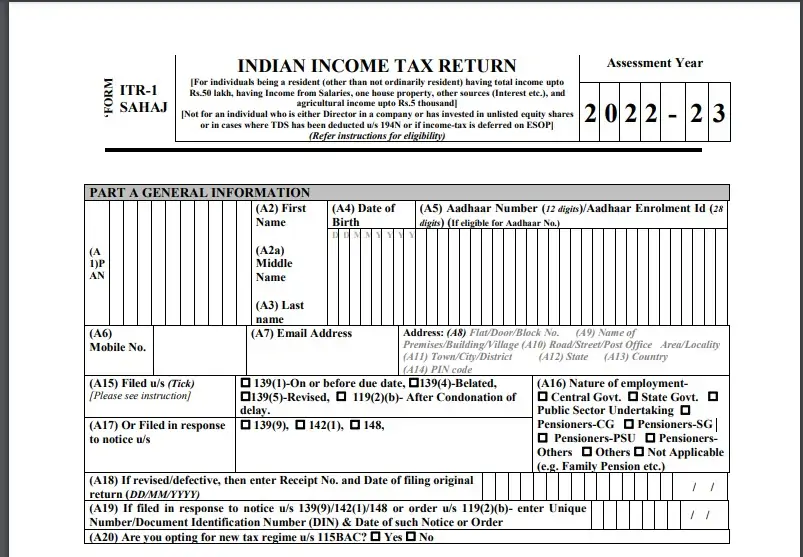
ITR-1 Sahaj Form is made up of the following sections:
Get FREE Credit Report from Multiple Credit Bureaus Check Now
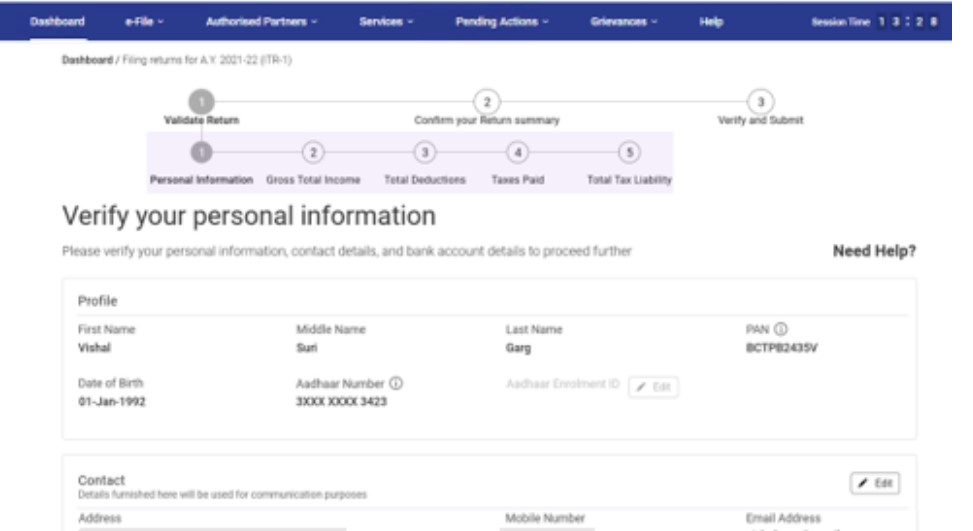 Procedure for Completing Form ITR-1 Online
Given below is the step-by-step process to fill and submit your ITR-1 Sahaj Form online:
Read More: To know more about Income Tax e-filing, click here.
For taxpayers who choose to submit their returns via the electronic or online mode, the acknowledgement copy is mailed by the I-T Department on their registered e-mail ID. They can also download the same from the Income Tax website. Taxpayers who use the physical form to submit their returns, receive their acknowledgement copy from the I-T Department after the submission of the form.
Get FREE Credit Report from Multiple Credit Bureaus Check Now
Q1. Am I required to show interest income from other sources when filing ITR-1 even if the TDS is already deducted?
Yes, you are required to include interest income from other sources even if the TDS is already deducted.
Q2. I am a joint owner of a property with my wife. Can I file ITR-1 in AY 2022-23?
Yes, you can file ITR-1 for the AY 2022-23 only if you are a single/joint owner of a single property. In case you own more than one property, you can’t file ITR-1 even as a single owner.
Q3. How am I required to report bank accounts in ITR-1?
You need to fill in details of all your savings and current accounts held during the previous year. However, it is not mandatory to add details of dormant accounts that haven’t been operational for more than three years. The bank account numbers have to be filled in Part E of the ITR-1 Form.
Q4. Am I supposed to include dividend income from mutual funds in ITR-1 Form?
Yes, dividend income from mutual funds is taxable and must be shown under ‘Other Income’ in ITR-1 Form.
Q5. My annual income is Rs. 52 lakh. Should I file ITR-1 or ITR-2?
Since your income is more than Rs. 50 you cannot file ITR-1. However, based on the course of your income, you can file ITR-2 or ITR-3. If you are salaried, you can file ITR-2 and in case you are an entrepreneur, you can file ITR-3.