Download the
Paisabazaar app Today!
Paisabazaar app Today!
Get instant access to loans, credit cards, and financial tools — all in one place

Win Assured Cashback

Our Advisors are available 7 days a week, 9:30 am - 6:30 pm to assist you with the best offers or help resolve any queries.


Get instant access to loans, credit cards, and financial tools — all in one place

Scan to download on



 Personal Loan
 Business Loan
 Home Loan
 Other Loans


Our Advisors are available 7 days a week, 9:30 am - 6:30 pm to assist you with the best offers or help resolve any queries.
Tax is an important tool that helps the government charge a fee from residents and use it to carry out its operations. A resident pays taxes in different forms. Let us learn about various taxes charged from residents and other details.
600 or 750? What's your credit
score? Check for FREE.


Let’s Get Started
 +91
+91
The entered number doesn't seem to be correct
Tax helps the government in carrying out development work in the country, improving the standard of living and building a stronger future for residents. These taxes come in various forms such as state taxes, central government taxes, direct taxes, indirect taxes and so on.
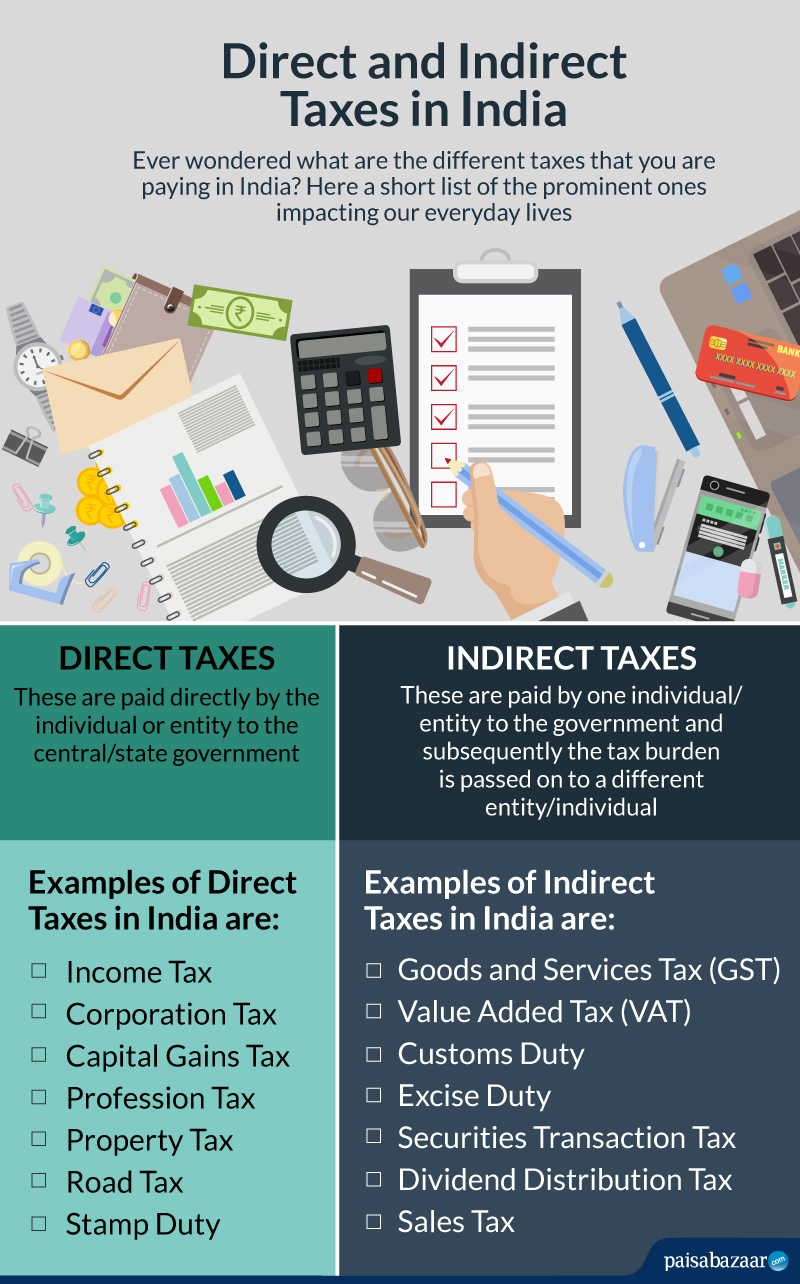
To understand easily, let us divide the types of taxes payable in India into two categories – direct taxes and indirect taxes. This differentiation is based on how the tax is being paid to the government. In the following sections, we will discuss in brief the common taxes that an Indian resident is liable to pay. The word tax comes from a Latin word “taxo”. A tax is a compulsory fee or financial charge levied by a government on an individual or an organisation to raise revenue for public works. The collected amount is then used to fund different public expenditure programmes. Failure in payment of taxes or resisting to contribute towards it invites punishment under the pre-defined law. An entity has to pay taxes in various forms. Depending on the manner in which they are paid to the taxation authorities, these taxes are classified into direct and indirect taxes. Let us discuss about both taxes in detail:
Get FREE Credit Report from Multiple Credit Bureaus
Check Now
Taxes are basically the fuel on which a government runs and provide public services to its citizen. Below-mentioned are the benefits of paying taxes: The government introduced Goods and Services Tax (GST) in 2017 which is the most important tax reform in independent India till date. Earlier, governments levied various state and central taxes for availing various services or buying different goods. The taxation was complex and contradicting rules enabled some people to evade taxes through loopholes in the system. After the introduction of GST, higher percentage of assessees was brought in the taxation umbrella and it made tougher for evaders to escape from paying taxes. The Government of India has made various Acts related to taxation and every citizen is liable to comply with the rules mentioned in them failing which strict actions may be taken on them. Below-mentioned are some sections of the taxation laws and penalties imposed for non-compliance: This is the most common type of tax that an individual citizen pays to the government. The concept is pretty simple – a portion of your income is paid to the government every year and this money is used by the government to fund its growth and development activities across the country.
Get FREE Credit Report from Multiple Credit Bureaus
Check Now
Any individual who is liable to file taxes as a result of having an income is an income tax assessee. However, not all individuals who have an income are actually required to pay taxes. Common reasons for not having to pay taxes include annual income below a threshold level determined by the government from time to time or income from exempted sources such as agriculture. Additionally, an income tax assessee may be responsible for filing tax returns for himself/herself or on behalf of another person depending on specific situations. Not all individuals are liable to pay the same amount of tax, the rule of thumb is the higher your income, the higher amount of tax you have to pay. In order to ensure that taxation rates and rules are fair rather than uniform, the government uses income tax slabs to determine the rate at which each individual tax assessee is liable to pay income tax. Given below are the income tax slab rates for the financial year 2025-2026 (AY 2026-2027) are as follows: Apart for the applicable tax level, surcharge and cess are applicable in case certain threshold income levels are exceeded. Those who have taxable income in excess of Rs. 2.5 lakhs are liable to pay income tax as per their applicable slab. However, there are a few tax savings options that can be used to reduce the income tax payable by the individual. Examples of such deductible expenditures include ELSS, Mutual Funds, PPF, EPF, tax saver fixed deposits, post office saving schemes, life insurance, health insurance and others. A majority of these deductible expenditures are available under sections 80C and 80D of the Income Tax Act, 1961.
Get FREE Credit Report from Multiple Credit Bureaus
Check Now
Tax Deducted at Source or TDS is considered to be one of the most common ways a salaried individual’s tax is paid by the employer to the government. In this case, investment declarations provided during the current/previous year, are used to determine the tax liability of the individual and this amount is equitably distributed and deducted from the salary payable every month. In case further deductions are availed by the individual at a later date, the excess TDS with interest (if applicable) is refunded to the employee. Other cases of TDS can occur in the case of interest paid on fixed deposits. In this case also, the tax assessee can get a refund after filing the Income Tax Return (ITR). In case a taxpayer has overpaid his/her income tax as a result of excess TDS deducted by the employer or incorrect advance tax calculation, he/she is liable to receive an income tax refund from the Income Tax Department. However, this refund can be claimed only in case the taxpayer has filed the ITR. Such refunds may include interest payable to the individual based on the amount refunded to the individual taxpayer. After the end of each financial year, individuals whether salaried or self-employed, are required to submit their income tax returns or ITR. This document provides a snapshot of the taxpayer’s annual earnings from various sources, tax saving investments/expenditure, total tax liability, TDS/advance tax paid and some other data depending on whether the person filing the ITR is salaried or self-employed. After submission of ITR, the Income Tax Department issues an acknowledgment number and the assessing officer checks accuracy of the ITR filed before issuing refunds or seeking explanations if any from the assessee. As with any type of notice sent out by the government, an Income Tax Notice is often believed to be a bad sign. Where in fact, all it might be is a clarification request regarding some aspect of your ITR. Earlier such notices were sent out using the postal system, but over the years, this has changed and with the advent of e-Filing, the Income Tax Department sends out emails that ask you to log on to your e-Filing account and view the notice you have received. No matter what, such a notice must never be ignored and responded to in the prescribed manner. If the IT Department does not get a response from you subsequent to sending out multiple notices, they can initiate criminal proceedings against you or fine you depending on the severity of your situation. Considered to be the greatest tax reform that India has undergone since its independence, the Goods and Services Tax or GST is all set to be implemented from July 2017. This indirect tax is designed to provide uniformity to taxes levied on products and services across India. To that effect, the GST will replace all other taxes levied by the state and central governments. As per currently available data, goods and services will be taxed according to specific rates of 0%, 5%, 12%, 18% or 28%, while a few other goods/services have been classified as exempt. This was one of the leading indirect taxes of the pre-GST era in India and this is pretty common all over the world. VAT is applied whenever there is a value-addition to the inputs/raw materials used in order to produce the final product for sale. If a certain product is bought and sold multiple times as raw material or semi-finished product till it is available as the final product, the VAT will be applicable in each downstream step provided there is a value-addition activity involved. Vat is still being applied on petroleum products like petrol, diesel, etc. This is an indirect tax levied on the sale of goods or services and is an integral tax during the pre-GST period. As opposed to VAT, sales tax is considered to be an ad -valorem tax as it is computed based on the gross value of the sale even if there is no value addition. Sales tax is often considered to be a tax on tax or double taxation situation as it is levied every time a good or service is sold irrespective of whether there has been an increase in value or not. Introduced in India as part of the Finance Act, 1994, the service tax is best defined as an indirect tax payable to the government by a pre-determined group of service providers. These service providers subsequently pass this tax on to their customers. Some of the common examples of establishments that charge customers service tax include hotels, restaurants, mobile connection providers, etc.
Get FREE Credit Report from Multiple Credit Bureaus
Check Now
Get FREE Credit Report from Multiple Credit Bureaus
Check Now
Get FREE Credit Report from Multiple Credit Bureaus
Check Now
Ans – Yes, everyone pays tax to some extent. While some taxes such as income tax come with a minimum exemption limit i.e. no tax is payable if you earn less than a certain amount annually, the same does not apply to indirect taxes such as GST which is applicable at the same rate to all who avail a particular product or service. So in effect everyone has to pay a tax in one way or another. Ans – The final decision of fixing tax rates lies with the Government of India. However, there are several departments and bodies that suggest and implement tax rates and taxes to the government. Some of the major ones are CBDT (Central Board of Direct Taxes) and the GST (Goods and Services Tax) Council. Ans – The following are some of the key tax incentives available in India: Start-up India Scheme Ans – A progressive tax is best defined as a tax system where the rate of applicable tax increases with an increase in the taxable amount. This is true in case of income tax in India as the rate of taxation termed as the income tax slab rate increases as the income of the tax assessee increases. Ans – The primary goal of imposing taxes such as income tax and goods and services tax (GST) is the generation revenue. This revenue is subsequently channelled into other areas such as maintaining roads and public utilities, national defence funding public welfare initiatives and more.
How To File
What is
How to Calculate
e-Filling Income Tax
GST
TDS Rates
IncomeTax Return
Income Tax
GST Rates
Advance Tax
E- Way Bill
TDS on Salary
TDS Return
TDS
HRA Calculations
What is Tax
Types of Taxes
Direct Tax

Indirect Tax
Benefits of Paying Tax
Recent Changes in Taxes
Tax Evasion Laws and Penalty
Income Tax
Income Tax Assessee
Income Tax Slabs
Income Tax Slab for Individuals for FY 2025-26 (AY 2026-27)
Old Tax Regime
New Tax Regime
Income Slab
Income Tax Rate
Income Slab
Income Tax Rate
Up to Rs. 2,50,000
Nil
0 – Rs. 4,00,000
Nil
Rs. 2,50,001 – Rs. 5,00,000
5% above Rs. 2,50,000
Rs. 4,00,000 – Rs. 8,00,000
5%
Rs. 5,00,001-Rs. 10,00,000
Rs. 12,500 + 20% above Rs. 5,00,000
Rs. 8,00,000 -Rs. 12,00,000
10%
Above Rs. 10,00,000
Rs. 1,12,500 + 30% above Rs. 10,00,000
Rs. 12,00,00 – Rs. 16,00,000
15%
Rs. 16,00,000 – Rs. 20,00,000
20%
Rs. 20,00,000 – Rs. 24,00,000
25%
Above Rs. 24,00,000
30%
Old Tax Regime
New Tax Regime
Income Slab
Income Tax Rate
Income Slab
Income Tax Rate
Up to Rs. 3,00,000
Nil
0 – Rs. 4,00,000
Nil
Rs. 3,00,001 – Rs. 5,00,000
5% above Rs. 3,00,000
Rs. 4,00,000 – Rs. 8,00,000
5%
Rs. 5,00,001-Rs. 10,00,000
Rs. 10,000 + 20% above Rs. 5,00,000
Rs. 8,00,000 -Rs. 12,00,000
10%
Above Rs. 10,00,000
Rs. 1,10,000 + 30% above Rs. 10,00,000
Rs. 12,00,00 – Rs. 16,00,000
15%
Rs. 16,00,000 – Rs. 20,00,000
20%
Rs. 20,00,000 – Rs. 24,00,000
25%
Above Rs. 24,00,000
30%
Old Tax Regime
New Tax Regime
Income Slab
Income Tax Rate
Income Slab
Income Tax Rate
Up to Rs. 5,00,000
Nil
0 – Rs. 4,00,000
Nil
Rs. 5,00,001 – Rs. 10,00,000
20% above Rs. 5,00,000
Rs. 4,00,000 – Rs. 8,00,000
5%
Above Rs. 10,00,000
Rs. 1,00,000 + 30% above Rs. 10,00,000
Rs. 8,00,000 -Rs. 12,00,000
10%
Rs. 12,00,00 – Rs. 16,00,000
15%
Rs. 16,00,000 – Rs. 20,00,000
20%
Rs. 20,00,000 – Rs. 24,00,000
25%
Above Rs. 24,00,000
30%
Income Tax Deductions
Tax Deducted at Source
Income Tax Refund
Income Tax Return
Income Tax Notice
Goods and Services Tax (GST)
Value Added Tax (VAT)
Sales Tax
Service Tax
Entry Tax
Infrastructure Cess
Krishi Kalyan Cess
Swachh Bharat Cess
Road Tax
Toll Tax
Education Cess
Stamp Duty
Entertainment Tax
Property Tax
Professional Tax
Interest Tax
Expenditure Tax
Gift Tax
Excise Duty
Custom Duty
Corporate Tax
Securities Transaction Tax
FAQs on Taxes
Q – Does everyone have to pay tax?
Q – Who decides the rate of tax in India?
Q – Name some of the key tax incentives in India?
Investment-linked tax incentives
R&D expenditure-linked tax benefits
Capital gains tax concessions, concessions on minimum alternate tax, etc.
Q – What is a progressive tax and which tax in India is progressive?
Q – Why do governments impose tax?