Download the
Paisabazaar app Today!
Paisabazaar app Today!
Get instant access to loans, credit cards, and financial tools — all in one place

Win Assured Cashback

Our Advisors are available 7 days a week, 9:30 am - 6:30 pm to assist you with the best offers or help resolve any queries.


Get instant access to loans, credit cards, and financial tools — all in one place

Scan to download on



 Personal Loan
 Business Loan
 Home Loan
 Other Loans


Our Advisors are available 7 days a week, 9:30 am - 6:30 pm to assist you with the best offers or help resolve any queries.
A fire has the potential to destroy a property or a business, leading to losses of great scale. To get compensated for such losses, you can opt for fire insurance, covering your movable and immovable property. The property that you want to insure could be residential, commercial or industrial.
Table of Contents:
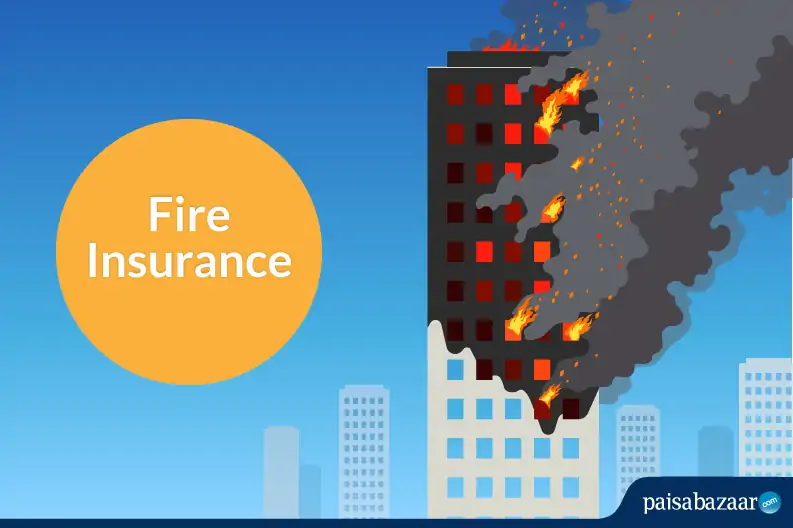
A fire insurance could be bought as a part of property insurance or as a stand-alone policy. It offers compensation for the costs incurred in the replacement, repair or reconstruction of a property that was damaged due to fire. Since the estimation of loss from fire is unpredictable, this policy is issued with fixed value compensation as an upper limit set by the property insurance policy. The actual loss or the maximum amount agreed beforehand is paid as compensation when you file a claim for fire insurance.
To avoid ambiguity for the claim amount, certain types of clauses are included in this policy. Such types give more clarity on premium payable and claim amount payable without any scope of a dispute. Businessmen should be clear about the type of policy they need and whether it suits his/her business operations. Let us look at some of the types of fire insurance.
a) Valued Policy: When it is difficult to ascertain the value of the property or articles at the time of claim, a valued policy is issued. For example, the value of paint or art or jewellery is not constant during all the days of the year. For such cases, the estimated value is fixed in advance by the insurance company and policyholder, at the time of taking the insurance. In case of an unfortunate event, the predetermined value is paid, and actual loss is not assessed. Here the principle of indemnity is not applied, but the attempt is made to compensate the losses to the insured at a predetermined rate without entering into debates or disputes at the time of actual loss.
b) Specific Policy: Under this policy, the maximum amount payable is fixed in advance. In case of an unfortunate event, the amount equivalent to the actual loss or prefixed amount, whichever is less, is paid. For example, if a fire insurance policy is taken with a specific value of Rs. 2 lakh, then in case the loss due to fire is worth Rs.3 lakh, the amount payable is Rs. 2 lakh. However, if the loss is worth Rs. 1.5 lakh, the full amount of Rs. 1.5 lakh will be payable.
c) Average Policy: Many a times, the applicant prefers the insured amount to be less than the value of the property. In such cases, the insurance company imposes the “average clause” to penalise the insured for taking up a policy less than the value of the property. For example, the valuation of your shop and goods inside the shop is Rs. 20 lakh, but you are taking a fire insurance of Rs. 10 lakh. In such a situation, if a fire in the shop leads to damage worth Rs. 20 lakh, the insurance company will pay you Rs. 10 lakh only, under the average policy clause.
d) Floating Policy: If a businessman has warehouses at different locations, s/he may opt for a floating policy. With the help of this single policy, all the goods lying in different warehouses can be insured together. Such an arrangement eliminates the need for buying separate policies for every warehouse. Moreover, you can opt for an average clause if you want to reduce the premium. However, at the time of loss, the amount payable is substantially lower than actual loss, in case of the average clause.
e) Consequential Loss Policy: The loss due to fire is not the only loss an insured person faces after fire break. Your factory may lose important machinery and the production line could go down for several weeks or months after the fire. The loss of production is a loss of business or profit. Such indemnity can be claimed under consequential loss policy. The business in which continuous production is the essence must take consequential loss policy to make good of such losses.
f) Comprehensive Policy: It can happen that business owners want to cover their properties against all possible mishaps like fire, burglary, theft, explosion, earthquake, lightning, labour unrest, and similar other reasons. In such a case, the business owner should go for comprehensive policy or all risk policy, which can take care of all possible causes of loss.
g) Replacement Policy: The loss of property due to fire raises the need to get a new property to restart business operations.
The policy comes with two variants. In the first option, it makes good of lost property on depreciated value bases. Alternatively, it makes good to compensate for the actual cost of the replaced property. While taking the fire insurance, you must understand the replacement policy clause to get appropriate claim at the time of the unfortunate event.
It covers all the losses arising out of the accidental fire, subject to terms and conditions of the fire policy which is limited by the policy value and not by the extent of damage sustained by the property owner. In general, the following losses are covered:
If you happen to encounter an eventuality because of fire, you need to make claims under fire insurance. To avoid rejection and fasten the claim process, you should be clear of the procedure and the documents needed.
Not all situations and cases are covered by fire insurance. Some situations are excluded.
This list does not include all the exclusions as they vary for different providers
The concept of a fire insurance is based on three essential conditions which should be met before you can file a claim
Considering the amount that the insurance company can pay for the losses and save you from further problems, you should not ignore and underestimate fire insurance. Let us look at some of the advantages of buying this policy:
Also Read : What is Commercial Insurance – Coverage, Claim & Exclusions
Q1. How will my insurance claim be cross-checked?
The insurance provider may ask for documented proof for the claim as well as inspect the insured property to ascertain the damage. If both these evidence are aligned, your claim is likely to get approved right away. Property owners are advised to document the property and its content as this doing this will simplify the assessment process of damaged goods during the fire.
Q2. Do I need a fire insurance if I have a comprehensive insurance policy?
No, if you have a comprehensive policy for your property, it is likely to also cover the damage caused due to fire.
Q3. Do I need to have fire insurance apart from a homeowner’s insurance?
No, if you have a homeowner’s insurance, you would also be getting cover for damage caused by natural calamities or fire. However, if the fire insurance is excluded from your standard homeowner’s insurance policy, then make sure you purchase it separately if your property contains valuable items that are not covered under this policy.