Download the
Paisabazaar app Today!
Paisabazaar app Today!
Get instant access to loans, credit cards, and financial tools — all in one place

Get the app — instant card and loan offers!

Our Advisors are available 7 days a week, 9:30 am - 6:30 pm to assist you with the best offers or help resolve any queries.


Get instant access to loans, credit cards, and financial tools — all in one place

Scan to download on


 Personal Loan
 Business Loan
 Home Loan
 Other Loans


Our Advisors are available 7 days a week, 9:30 am - 6:30 pm to assist you with the best offers or help resolve any queries.

Are you new at your job and have seen your salary slip for the first time? Don’t get overwhelmed with a lot of terms and numbers in it. Read this article to understand what is covered in your salary slip and why it is important for you to know about it in detail.
Also known as a pay slip, a salary slip is an official document issued every month to an employee by the employer. It contains the earnings and deductions of an employee, apart from a few additional details.
The salary slip is an important document that can not only be used to show your employment, but it also acts as proof of income and tax filing details.
An employee needs to provide a salary slip at the time of taking new loans or credit cards, visa application, job change, etc.
It is important to understand the components of the salary slip, as it will not only help you become aware of your salary components but also assist you in saving taxes if you subscribe to the old tax regime.
Also Read: What is Basic Salary
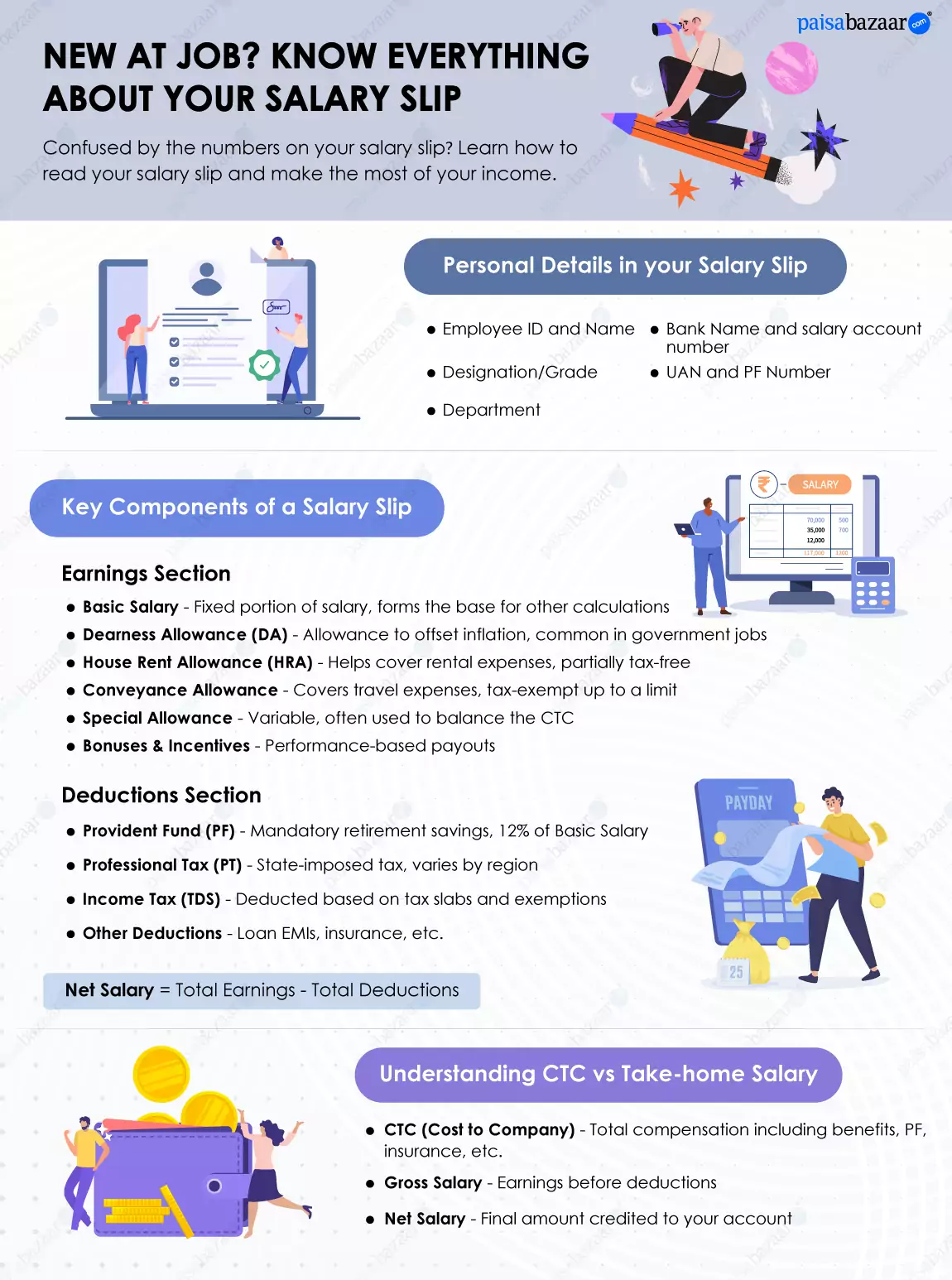
Let’s make your salary slip easier to understand by categorizing it into three key sections: Personal Details, Earnings, and Deductions.
This section contains an employee’s personal information and account details. Some entries in this section may vary from one employer to another. However, most employers provide the following information in this section:
This section contains all earnings from different heads for an employee that are provided by an employer. Various earning heads are described in detail below:
This section lists all deduction heads under which deductions are made from the salary of the employee.
Suggested Read: Employees’ Provident Fund (EPF)
The salary package that you were promised at the time of joining is quite different from what you get every month in your bank account. This is because CTC is different from your take-home salary. Let us understand it in detail below:
Cost to Company or CTC is the total amount an employer spends on the employee in a year. It includes the monthly salary, benefits, bonuses, and even retirement contributions.
CTC is made up of multiple components – fixed component, variable pay, benefits and contributions, such as EPF, gratuity, health insurance, etc.
It is worth noting here that the employee’s Income Tax is not calculated on the basis of the CTC.
Gross salary is the total salary of an employee calculated based on earnings throughout the year. It does not contain any deductions like taxes, provident fund (EPF), or professional tax.
Read in Detail: Gross Salary
Take-home salary is the actual amount credited to your bank account every month. It is calculated after adding all earnings and removing all exemptions and deductions from the CTC.
To make it understandable, your net salary is the amount that is calculated after deducting income tax from your gross salary and other deduction components.
| Net Salary = Total Earnings – Total Deductions |
Read in Detail: How is Net Salary Calculated
Your employer shares your salary slip every month. If you don’t receive it, contact HR or the concerned person in your company to get it.
It is recommended that you check your salary slip every month. It shall help you:
This shall help you plan your finances better and also plan investments in coming future, especially if you have subscribed for the old tax regime.