Download the
Paisabazaar app Today!
Paisabazaar app Today!
Get instant access to loans, credit cards, and financial tools — all in one place

Win Assured Cashback

Our Advisors are available 7 days a week, 9:30 am - 6:30 pm to assist you with the best offers or help resolve any queries.


Get instant access to loans, credit cards, and financial tools — all in one place

Scan to download on



 Personal Loan
 Business Loan
 Home Loan
 Other Loans


Our Advisors are available 7 days a week, 9:30 am - 6:30 pm to assist you with the best offers or help resolve any queries.
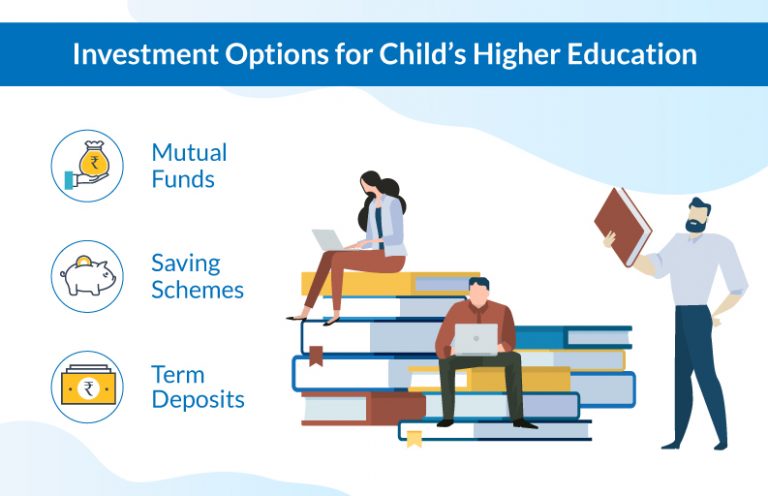
Considering the demand and value of information and knowledge, education in India has become more expensive than ever. As per the data released by the National Sample Survey Office, the average annual expenditure on the private schooling of a child has increased by a whopping 175% in the last 10 years. During the same period, the cost of professional or technical education increased by 96%.
Considering the expenses that your future may hold, it is clear that now is the best time that you start saving for your child’s education. To begin, you must develop a financial strategy depending upon your needs, implement it with a sound investment portfolio and maintain it for as long as you can. With little research and effort, you can become your own financial planner and in almost no time will you land up with sufficient corpus for your child’s education.
Let’s consider the rapid increase in the cost of higher education in India depending upon the current scenario. A 2-year post-graduate program at IIM Calcutta cost around 4.3 lakh in the year 2007. The same amount rose to 16.6 lakh in 2013 and 23 lakh in 2020. The education expense for such a course in a prestigious college would ask for a fortune in the years to come. Even if this amount increases by 10% every year, you will have to pay an amount approximately equal to Rs.60 Lakh in another 10 years for your child’s education fee at this premier business school.
To be clear, undergraduate courses are not behind either. The tuition fee of all IITs increases by Rs. 2 lakh per year; this amount in the earlier years, was Rs.90,000. And this does not include all the expenses that form part of one’s life at college, whether academic or non-academic.
| Class of 2007
(Amount in Lakh) |
Class of 2018
(Amount in Lakh) |
Change (%) | |
| IIM Ahmedabad | 4.3 | 19.5 | 353 |
| IIM Bangalore | 5 | 19.64 | 293 |
| IIM Kolkata | 5 | 19 | 280 |
| IIT (Engineering) | 3.6 | 8 | 122 |
The above table shows the change in tuition fees of premium education institutes in the last decade (fees amount taken in approximation)
Based on the above calculations, if you have a 1-year-old child now, you would need to create a total corpus of Rs. 42 lakh for paying just the tuition fees of an Engineering degree. The tuition fee is even higher at Rs 46 lakh for funding an MBA education for your child. Hence, you must plan accordingly in order to be able to save regularly and invest effectively to fund your child’s education and safeguard his/her future.
Many investors opt for child plan instead of mutual funds when planning for their children’s education expenses. However, there are a number of reasons that favor mutual fund investments in comparison with child plans while planning for children’s higher education.
There is no question over the fact that mutual funds feature various advantages over many other traditional investment options. In case you are new to mutual funds or are busy following a DIY investment strategy, you may also get in touch with an experienced fund manager who can do the job on your behalf.
The following are a few tips to help you get started-
Also Read: Best Mutual Fund for Child’s Future
Let’s consider that you want to invest Rs. 5,000 per month and that your child is aged about 5 years at present. If we consider an average return of 12% on your investment, by the time your child goes to college, which would be around 13 years down the line, your total corpus would be worth Rs.18.61 lakh (approx). The rate of return, however, does depend on the type of fund invested in. Moreover, even if the investment is done in the most conservative way, equity mutual fund returns over the long term have been observed to range between 10% and 12%.
On top of this, if you are able to increase the total annual SIP amount, a larger fund can be accumulated. In the above scenario, if the amount of investment per month is increased by 20% annually, your total accumulated corpus should be worth over Rs. 1 Crore by the time the child is ready for college. This is known as the concept of compounding. Considering that, on average, your income will continue to increase, investing more through SIP should be a definite possibility.
Deciding to invest in mutual funds is only the first step. Selecting which fund to invest in is a bigger choice to make. Hence, you must undertake research about how to invest in mutual funds, which funds have delivered remarkable historical returns over the long term, how much risk you can afford and what investment horizon is.
The choice must be made depending upon your specific requirements of generating adequate corpus in the long term to fund your child’s education. You must carefully keep a check on the following before you make your decision-
When it comes to investing in mutual funds, starting early is the key to ensuring that your finances are less burdened. For instance, if you start saving for your child’s college education (required at approximately 18 years of age) when the child reaches 5 years of age, you will have to invest only Rs. 6,700 per month to reach a goal of Rs. 25 lakh. Further, if you start saving after the child reaches 11 years of age, the invested amount per month will go up to Rs. 19,000 (assuming equity return of 12% p.a. in both cases).
As in every case, understanding how mutual fund investment is useful for beginners can serve as the first step to developing an investment plan that is ideally suited to your specific needs.
Suggested Read: Top Mutual Fund Schemes for Child’s education
To sum up, here are a few key points to keep in mind while planning to save for your child’s education-
