Download the
Paisabazaar app Today!
Paisabazaar app Today!
Get instant access to loans, credit cards, and financial tools — all in one place

Win Assured Cashback

Our Advisors are available 7 days a week, 9:30 am - 6:30 pm to assist you with the best offers or help resolve any queries.


Get instant access to loans, credit cards, and financial tools — all in one place

Scan to download on



 Personal Loan
 Business Loan
 Home Loan
 Other Loans


Our Advisors are available 7 days a week, 9:30 am - 6:30 pm to assist you with the best offers or help resolve any queries.
Table of Contents :
Launched in November 2017, Bharat 22 ETF tracks performance of the Bharat 22 Index, which comprises of 19 public sector units and 3 privately owned companies. This foundation was laid by the government in the Union Budget of 2017 as a medium to achieve its targets of disinvestment. Bharat 22 Index remains the top choice of the government’s current disinvestment plans.
The Indian government plans to raise Rs. 3500 crore through this additional offering managed by ICICI Prudential Asset Management Co. Ltd. Investors who subscribe to Bharat 22 ETF will be offered an additional discount of 5% on the reference price. This amount can be calculated as the volume weighted average price of its constituents on the offer date.
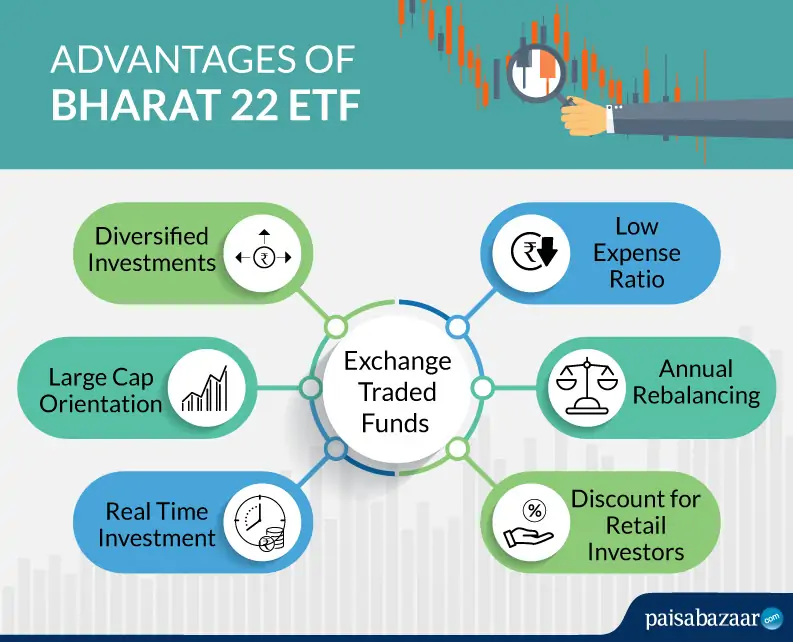
Exchange Traded Funds are marketable securities that track a specific commodity, bonds, index or a combination of assets such as the Index fund.
Also Read: Bharat Bond ETF
The Bharat 22 ETF would mirror the performance of the Bharat 22 Index therefore it would invest in equities of the 22 companies that comprise its chosen index. The capital allocation to individual company equity by the ETF is expected to be the same as the individual weight of each company featured on the Bharat 22 Index. Any variations between the Index returns and the fund returns would be a result of tracking error.
The Bharat 22 Index comprises of 22 stocks of Central Public Sector Enterprises (CPSE), Public Sector Banks and private companies which are Strategic Holding of Specified Undertaking of Unit Trust of India (SUUTI), spread across six sectors (Basic Materials, Energy, Finance, FMCG, Industrials and Utilities). The index invests a maximum of 15 per cent in a single stock and 20 per cent in a particular sector.
| Company | Sector | % Assets |
| Larsen & Toubro | Construction | 16.33 |
| ITC | FMCG | 13.21 |
| State Bank of India | Financial | 10.16 |
| Axis Bank | Financial | 8.60 |
| NTPC | Energy | 7.53 |
| Power Grid Corporation | Energy | 6.44 |
| ONGC | Energy | 6.10 |
| Coal India | Energy | 4.79 |
| GAIL | Energy | 4.50 |
| Indian Oil Corp | Energy | 4.49 |
| BPCL | Energy | 4.01 |
| National Aluminium | Metals | 3.96 |
| Bharat Electronics | Engineering | 2.66 |
| NBCC India | Construction | 1.54 |
| Bank of Baroda | Financial | 1.16 |
| REC | Financial | 1.10 |
| Engineers India | Construction | 0.92 |
| Power Finance Corp | Financial | 0.85 |
| NHPC | Energy | 0.80 |
| Indian Bank | Financial | 0.22 |
| NLC | Energy | 0.20 |
| SJVN | Energy | 0.16 |
The above numbers have been recorded as of June 3o, 2019 (Source: Value Research).
The relative capital allocation of the fund to each sector would be dependent on the weight assigned to individual securities featured on the index. These weights are rebalanced annually.
Bharat 22 ETF is intended for investors who look for long term wealth creation through a diversified portfolio. The scheme has a lock-in period of 30 days from the date of allotment for anchor investors. For the others, including retail investors retirement funds, qualified institutional buyers and non-institutional investors, there is no lock-in period.
The FFO was last opened for subscription from June 20 to June 22, 2018 for retail investors. The applications can be submitted via both online and offline mediums. For offline subscriptions, the applications can be submitted to any of the ICICI Prudential AMC or CAMS service centre. Online subscriptions can be submitted on the ICICI Prudential website, IPRUTOUCH mobile application or other platforms like BSE Star MF, MF Utility, CAMSonline.com, etc.
It is important for one to have Demat account before investing in ETFs. However, the fund house has launched a Fund of Funds (FOF) scheme based on Bharat 22 ETF by the name of ICICI Prudential Bharat 22 FOF for the benefit of retail investors without a Demat account. The minimum application amount for retail investors is Rs. 5000 while the maximum amount is Rs. 2 Lakh.
Tax Implications
Profits from ETF investments are subject to short term capital gains and long term capital gains. The taxation treatment for Bharat 22 ETF is in line with other equity mutual fund schemes. Short-term capital gains held for upto 1 year are taxed at 15% plus surcharge and cess, as applicable. On the other hand, long-term capital gains held for more than more than a year, with gains exceeding Rs. 1 lakh, are taxed at 10%.
Tax Exemptions
This year’s budget announced that the government will offer an investment option in CPSE related ETFs, on the lines of Equity Linked Saving Schemes. ELSS are equity-oriented mutual funds with a lock-in period of 3 years and are eligible for 80C benefits.
Hereafter, under section 80C of the Income Tax Act, the investments made in ETFs will be eligible for exemption from tax for upto 1.5 lakh and will be subject to a lock-in period for 3 years.
Over subscription and Under Subscription
In case the FFO or Further Fund Offer is oversubscribed, the units of FFO will be allotted in proportion to the amount of the applications received. On the other hand, in the case of under subscription, all the units applied shall be allotted. Moreover, if there is any refund amount, in case of oversubscription or unsuccessful application, it will be directly credited to the registered bank account.
The maximum amount raised by Bharat 22 ETF shall be alloted as-
Anchor investors: Not exceeding 25% of ‘Maximum Amount to be Raised’
Non-Anchor investors:
The units of Bharat 22 ETF get listed on BSE and NSE within 5 working days from the date of allotment. Once listed, the units can be freely traded on the stock exchange like direct equity shares.
Bharat 22 ETF Second Tranche Witnesses Oversubscription on Day 1
High levels of interest by institutional investors groups including mutual fund houses, retirement funds and foreign portfolio investors have led to oversubscription by anchor investors in the second tranche of the ICICI Pru MF managed Bharat 22 ETF. The target subscription value for the current Bharat 22 ETF was fixed at Rs. 6,000 crores with Rs. 1,500 crores reserved for anchor investors of the scheme. As of now, anchor investor subscriptions worth an estimated Rs. 5,163 crores have already been received which is 3.44 times the original subscription amount reserved for this investor group.
ICICI Prudential to open Bharat 22 ETF on November 14th
Introductory Offer of Bharat 22 ETF
Bharat 22 ETF – The Best Way to Invest in Indian PSUs
Bharat 22 ETF NFO Receives Day 1 Subscriptions worth Rs. 12,000 Crores
The Bharat 22 ETF new fund offer (NFO) from ICICI Prudential Mutual Fund has received subscriptions valued at Rs. 12,000 crores on its very first day according to a news report published by Livemint. The ETF’s NFO was opened to investors on Tuesday, the 14th of November with anchor investor reservation of Rs. 2,000 crores. So in effect the Bharat 22 ETF has received 6 times the anchor investor reservation amount at the end of the first day itself, the Livemint report has pointed out. The NFO of this scheme will be open to retail investors till the 17th of November 2017. The Bharat 22 ETF invests in 22 leading public sector companies suitable for disinvestment and is expected to help the government meet its current Rs. 72,500 crores disinvestment target.
BSE StAR MF Emerges as Main Platform for Bharat 22 ETF NFO
During the recently concluded Bharat 22 ETF NFO, the BSE StAR MF platform has emerged as the major contributor having processed approximately 90% of all the NFO investment requests. The launch of the ICICI Prudential Mutual Fund AMC managed Bharat 22 ETF is believe to be a major step forward in the current government’s disinvestment plans. The NFO of this new scheme has garnered an estimated Rs. 14,500 crores which is huge step towards achieving the proposed Rs. 72,500 crores disinvestment target proposed by the government. Key contributors towards the Bharat 22 ETF include HDFC Ergo Insurance, EPFO, SBI Pension Fund, Bank of India and Life Insurance Corporation of India.
Q. Who will manage the Bharat 22 Exchange Traded Fund?
Ans – As per the instructions provided by the Government of India, Mr. Kayzad Eghlim, a fund manager from ICICI Prudential Mutual Fund AMC will manage the Bharat 22 ETF.
Q. Who should invest in Bharat 22 ETF?
Q. Is there any lock-in period for Bharat 22 ETF?
Q. When are the units allotted to the Customer? How?
Q. What happens in the case of oversubscription or under subscription?
Ans- If the ETF was undersubscribed, only units that were applied for would be allocated to the investors. However on the 1st day itself, the anchor investor requirement of Rs. 2000 crores was oversubscribed 6 times over i.e. to the tune of Rs. 12,000 crores. In case of oversubscription, the unit allocation would be made based on a predetermined formula as follows:
Q. How can I liquidate my investments in Bharat 22 ETF?
Ans- In case you are an anchor investor, you have to wait 30 days from the date of unit allotment before you can liquidate your investment. The Bharat 22 ETF will be listed on stock exchanges 5 days after closure of the NFO and can then be freely traded like any other equity stock listed on the exchange.
| Fund Name | 1 Year Return | 3 Year Return | 5 Year Return |
| Axis Bluechip Fund – Direct Plan | 22% | 21% | 11% |
| Mirae Asset Tax Saver Fund – Direct Plan | 18% | 20% | – |
| Axis Midcap Fund – Direct Plan | 18% | 19% | 12% |
| Axis Bluechip Fund – Growth | 21% | 19% | 10% |
| Axis Long Term Equity Fund – Direct Plan | 18% | 18% | 12% |
| Invesco India Growth Opportunities Fund – Direct Plan | 14% | 18% | 12% |
| Axis Midcap Fund – Growth | 16% | 18% | 10% |
| Mirae Asset Tax Saver Fund – Regular Plan | 16% | 18% | – |
| Mirae Asset Emerging Bluechip Fund – Growth | 16% | 17% | 16% |
| Kotak India EQ Contra Fund – Direct Plan | 14% | 17% | 11% |
| Canara Robeco Bluechip Equity Fund – Direct Plan | 18% | 17% | 10% |
| HDFC Index Sensex – Direct Plan Growth | 18% | 17% | 9% |
| Nippon India Index Fund Sensex Plan – Direct Growth | 18% | 17% | 8% |
| Mirae Asset Large Cap Fund – Direct Growth | 16% | 17% | 13% |
| Tata Index Sensex Direct Plan | 18% | 17% | 9% |
| Axis Small Cap Fund – Direct Plan | 23% | 16% | 13% |
| IIFL Focused Equity Fund – Direct Plan | 29% | 16% | 12% |
| JM Multicap Fund – Direct Plan | 19% | 16% | 11% |
| Axis Long Term Equity Fund – Growth | 17% | 16% | 11% |
| JM Tax Gain Fund – Direct Plan | 16% | 16% | 11% |
| Invesco India Growth Opportunities Fund – Growth | 13% | 16% | 10% |
| Canara Robeco Bluechip Equity Fund – Regular Plan | 16% | 16% | 9% |
| Canara Robeco Equity Diversified – Direct Plan | 14% | 16% | 9% |
| Canara Robeco Equity Diversified – Regular Plan | 13% | 16% | 8% |
| DSP Equity Fund – Direct Plan | 20% | 15% | 10% |
| JM Tax Gain Fund – Growth | 16% | 15% | 10% |
| Kotak India EQ Contra Fund – Growth | 12% | 15% | 9% |
| Mirae Asset Hybrid Equity Fund – Direct Growth | 15% | 15% | NA |
| Tata Retirement Savings Fund Moderate Plan – Direct Growth | 13% | 15% | 13% |
| Mirae Asset Emerging Bluechip Fund | 18.27% | 14.40% | 17.53% |
| Axis Small Cap Fund – Growth | 21% | 14% | 12% |
| IIFL Focused Equity Fund – Growth | 27% | 14% | 11% |
| DSP Equity Fund – Regular Plan | 19% | 14% | 9% |
| Aditya Birla Sun Life Tax Relief 96 – Direct Growth | 9% | 14% | 12% |
| Invesco India Mid Cap Fund – Direct Plan | 6% | 13% | 11% |
| Invesco India Infrastructure Fund – Direct Plan | 12% | 13% | 7% |
| L&T India Large Cap Fund – Direct Growth | 16% | 13% | 8% |
| DSP Equity & Bond Fund – Direct Growth | 17% | 12% | 11% |
| SBI Small Cap Fund | 8.33% | 11.28% | 17.04% |
| Canara Robeco Emerging Equities Fund | 10.38% | 11.25% | 13.89% |
| Tata Mid Cap Growth Fund – Regular Plan | 10% | 11% | 9% |
| Invesco India Infrastructure Fund – Growth | 10% | 11% | 6% |
| LIC MF Infrastructure Fund – Direct Plan | 15% | 11% | 5% |
| HDFC Index Sensex Fund – Growth | -2% | 11% | 8% |
| ICICI Prudential Equity & Debt Fund | 8.11% | 10.41% | 10.65% |
| ICICI Prudential Balanced Advantage Fund | 12.79% | 10.40% | 10.37% |
| LIC MF Infrastructure Fund – Growth | 13% | 10% | 4% |
| HDFC Hybrid Equity Fund | 9.44% | 9.50% | 10.22% |
| PGIM India Dynamic Bond Fund | 13.69% | 9.32% | 10.08% |
| SBI Magnum Medium Duration Fund | 11.77% | 9.31% | 9.80% |
| Kotak Asset Allocator Fund | 11.09% | 9.29% | 9.12% |
| Franklin India Dynamic Accrual Fund | 9.51% | 9% | 9.98% |
| DSP Natural Resources and New Energy Fund – Direct Plan | 0% | 9% | 11% |
| Kotak Emerging Equity Scheme | 11.35% | 8.38% | 12.89% |
| ICICI Prudential All Seasons Bond Fund | 11.28% | 8.24% | 9.91% |
| Aditya Birla Sun Life Balanced Advantage Fund | 9.99% | 8.20% | 9.46% |
| Nippon India Small Cap Fund (earlier Reliance Small Cap Fund) | -2.60% | 8.14% | 11.82% |
| DSP Natural Resources and New Energy Fund – Regular Plan | -1% | 8% | 11% |
| Motilal Oswal Multicap 35 Fund – Regular Growth | -10% | 8% | 15% |
| ICICI Prudential Bluechip Fund – Growth | -6% | 8% | 9% |
| Tata Retirement Savings Fund Moderate Plan – Regular Growth | -8% | 8% | 12% |
| Axis Strategic Bond Fund | 8.32% | 7.68% | 9.11% |
| SBI Magnum MultiCap Fund – Growth | -5% | 7% | 12% |
| L&T Tax Advantage Fund – Growth | -13% | 7% | 9% |
| Aditya Birla Sun Life Tax Relief 96 – Growth | -13% | 7% | 11% |
| L&T India Value Fund – Growth | -13% | 6% | 11% |
| DSP Equity Opportunities Fund – Growth | -8% | 6% | 10% |
| SBI Bluechip Fund – Growth | -6% | 5% | 10% |